

How to Decide Where to Travel (Without Guessing)
If you’re stuck on where to go, it’s usually because you’re trying to choose a destination without a decision framework. This page gives you a repeatable method to choose based on the experience you want, what it really costs, the timing tradeoffs, and whether it’s actually worth it.
From deciding where to go, to making it affordable — intelligently.

Why deciding where to travel feels so hard
The problem isn’t that you “don’t know what you want.” It’s that travel decisions bundle too many variables at once: money, time, weather, crowds, who you’re going with, and the fear of wasting your one precious vacation window.
When you try to pick a destination by scrolling Instagram, scanning flight deals, or asking friends for opinions, you’re mixing different goals together — and the decision stays fuzzy.
The fix is not “more research.” The fix is a better sequence — so each choice narrows the next.
The Travel Decision Stack
Most people start with destinations. That’s backwards. The right way to decide is to move through a simple stack of filters until the choice becomes obvious.
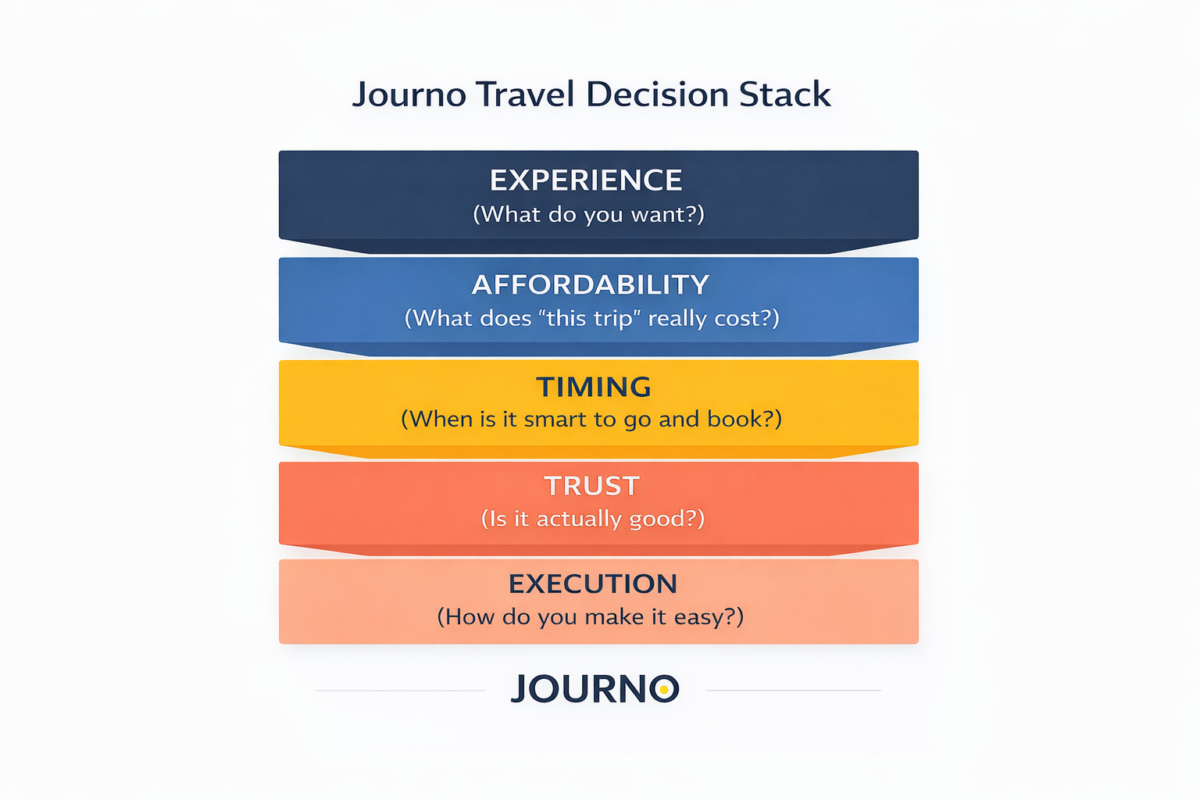
Layer 1: Experience
What are you actually optimizing for: rest, adventure, connection, food, culture, nature, “wow,” or momentum? If you can’t name the experience, you’ll keep second-guessing the destination.
If you want help making this step feel concrete, this article is a perfect companion: Rethinking the Way You Travel: Crafting Unique Travel Experiences.
Layer 2: Real cost
A cheap flight can still produce an expensive trip. Real cost includes accommodations, local prices, transportation, attractions, and your “mistake tax” when you book the wrong thing once.
If you’re trying to open up budget for travel, this is the classic: How To Save Money For Travel: 30 Small Ways To Save Big.
Layer 3: Timing
Timing changes price, weather, and crowds — which changes the entire experience. Many “overrated destinations” are actually amazing at the right time of year.
Start here: Shoulder Season And The Best Time Of The Year To Travel.
Layer 4: Execution and safety
Even a great choice can turn into a regret trip if the execution is sloppy: bad neighborhood, sketchy hotel, scams, unrealistic expectations, or logistics that consume the vacation.
This is the best “avoid regret bookings” companion: The Savvy Traveler’s Guide to Hotel Room Safety.
Step-by-step: choose your next destination in 20 minutes
Do this with a notes app. No spreadsheets. No perfectionism. The goal is to produce a shortlist of 3 and a winner.
Step 1 — Pick one “experience headline”
Fill in the blank: “This trip is for ______.”
- “This trip is for deep rest and heat.”
- “This trip is for food + walking + museums.”
- “This trip is for big nature and minimal logistics.”
- “This trip is for family-friendly fun with low friction.”
Step 2 — Set the constraints (the non-negotiables)
- Time window: exact dates (or a 2–4 week range)
- Trip length: nights you can actually take
- Budget ceiling: what you refuse to exceed (all-in)
- Energy level: chill, moderate, or ambitious
Step 3 — Generate 10 candidates fast (no overthinking)
Pull from any mix of: places you’ve saved, “cities with direct flights,” places friends recommended, or destinations that match your experience headline.
Step 4 — Cut to 3 using the Stack
For each candidate, score 1–5 on:
- Experience fit: does it match the trip purpose?
- Real cost fit: can you do it without financial stress?
- Timing fit: will it be pleasant, not punishing?
- Execution fit: low regret risk?
You’re not calculating anything perfectly. You’re using the stack to make the tradeoffs visible.
Step 5 — Pick the winner with one question
If you could only choose one and had to leave tomorrow, which destination would you feel genuinely excited about — and confident you can execute cleanly?
Want help applying this system to real trips, routes, and budgets? Journo’s flagship membership walks through the full optimization process step by step:
Start For Free & Go Everywhere →Common mistakes that create regret trips
1) Choosing a destination before choosing the experience
“We should go to Italy” is not a plan — it’s a vague direction. Italy can be rest, hustle, romance, food, chaos, crowds, museums, or countryside quiet. Choose the experience first, then pick the version of the destination that matches it.
2) Using flight price as the entire decision
Flights are just one line item. Lodging and local costs can dominate. The cheapest flight can lead to the most expensive trip.
3) Ignoring timing (then blaming the place)
A destination can be incredible in shoulder season and miserable in peak season. Don’t judge a place — judge the place at that time.
4) Underestimating execution friction
Long transfers, unsafe neighborhoods, “looks good on paper” hotels, and scams can steal time and money. Protect the trip like an investment.
Examples (so you can copy the thinking)
Example A — “I want rest, warmth, and low decision fatigue”
- Experience: heat + beach + minimal logistics
- Constraints: 6–8 nights, mid budget, easy flights
- Shortlist logic: pick destinations with short transfers + predictable weather
- Winner: often the place that’s easiest to execute cleanly, not the most exotic
Example B — “We want food, walking, and culture — but affordable”
- Experience: city vibe + cafes + museums + strollability
- Constraints: cost matters, shoulder season preferred
- Shortlist logic: pick cities where lodging + transit are sane, not just flights
- Winner: the place that matches the vibe without the peak-season tax
Quick checklist (printable in your head)
- What is the experience headline for this trip?
- What are the non-negotiable constraints (time, length, budget, energy)?
- What are 10 candidate destinations?
- Which 3 score best on Experience → Cost → Timing → Execution?
- Which 1 would you be excited to leave for tomorrow?
FAQ
What if I’m traveling with someone else and we want different things?
Start by agreeing on a single “experience headline” you both accept (even if it’s broad), then rank priorities: what matters most, what’s flexible, and what would ruin the trip. The stack works even better with multiple people because it forces tradeoffs into the open.
How far in advance should I decide where to travel?
Decide the destination as soon as your time window is real — especially for peak seasons, holidays, and family travel. If you’re flexible, you can decide later, but the best value usually comes from clarity early (so you can book intentionally).
What if my budget is tight — should I pick the cheapest place?
Not necessarily. Cheapest often becomes expensive through logistics, mistake tax, or hidden costs. Use the real-cost layer: lodging + local prices + transport + activities. Then choose the place that gives you the best experience per dollar, not the lowest sticker price.
Is shoulder season always the best time to travel?
Often, yes — but not always. Shoulder season is usually the best balance of price, weather, and crowds, but some destinations have unique patterns (rain, heat, festivals). Always sanity-check timing for the specific place.
How do I avoid “regret bookings” once I pick a destination?
Don’t rush lodging. Cross-check neighborhoods, scan recent reviews for patterns, and use a simple safety checklist. This guide is built for that: The Savvy Traveler’s Guide to Hotel Room Safety.
What to do next
If you want the broader “optimize everything about travel” framework, this pairs perfectly with what you just read: The Travel Optimization System.
And if you want help applying the system to real trips, routes, and budgets — with the goal of making travel dramatically more affordable — start here: Try It Yourself For Free Now.