Two people board the same flight to Lisbon. One paid $3,200 for four economy seats. The other paid $412 in taxes and fees for four lie-flat business-class seats — plus seven free hotel nights on arrival.
Same destination. Same dates. Completely different systems.
The second family isn’t wealthier. They’re not obsessed with points. They just built a simple system that runs in the background while they live their normal lives — and it compounds every time they travel.
That system is called travel optimization. This is the beginner’s guide to understanding what it is, why it works, and how to start.
- Travel optimization is a system, not a hack — it compounds over time
- The core move: earn transferable points, not airline-specific miles
- Most travelers leave 5–10× value on the table by redeeming points the wrong way
- You don’t need a higher income or more travel — you need a better system
- The full system lives at The Travel Optimization System →
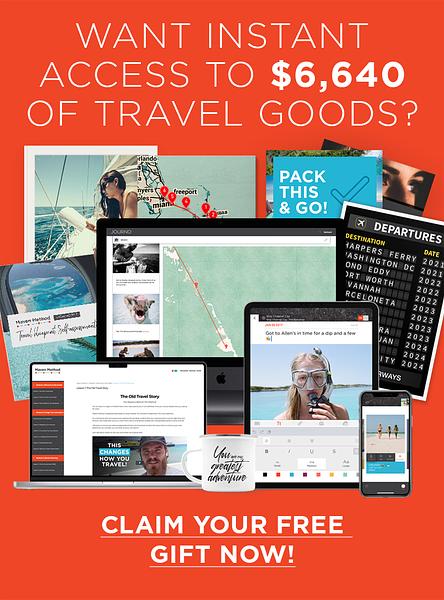
When you try Journo Insider today, you unlock The Syndicate course ($899), the Insiders Exclusive Library ($1,337), the Supercharged Travel Fund Challenge ($3,600), and more — all free for 14 days. Keep the gifts even if you cancel.
Claim your free gifts →14-day free trial. Keep everything even if you cancel.
What is travel optimization?
Travel optimization is the practice of treating your travel budget as a system rather than a series of transactions.
Most people book travel by reacting: searching for flights when they’re ready, picking the cheapest option that appears, paying whatever the airline or hotel charges. This is the default path — and it’s the most expensive one.
Travel optimization flips that sequence. Instead of reacting to prices, you build infrastructure in advance: the right credit cards, the right points programs, the right alliance awareness. Then when it’s time to travel, you’re not paying what everyone else pays. You’re redeeming currency you’ve already accumulated — often at 5 to 10 times the cash value.
Travel optimization = turning the money you already spend into outsized travel experiences, by routing that spending through systems designed to reward loyalty, not random transactions.
It is not travel hacking. It is not coupon collecting. It is not a side hustle.
It’s a system — and like any system, it compounds over time.
Why it works (and why most people miss it)
The travel industry is built on a simple premise: most travelers are reactive. Airlines, hotels, and booking platforms price for the reactive traveler — someone who searches at the last minute, compares on price alone, and has no accumulated leverage.
But the same industry has a parallel system designed for systematic travelers. Loyalty programs, alliance structures, and transferable points currencies exist specifically to reward people who plan ahead and funnel their spending intentionally.
The gap between these two paths is significant. Points and miles values range from roughly 0.4 cents to 3 cents per point depending on how they’re redeemed — a 7× spread between someone who redeems poorly and someone who redeems strategically. A business class seat that costs $6,000 in cash might cost 100,000 points redeemed well — that’s 6 cents per point in value, far above what most people ever achieve.
The core insight: The travel industry doesn’t hide this system. It just doesn’t advertise it. Most travelers simply never engage with it — not because they can’t, but because nobody showed them how.
This is why travel optimization isn’t about being wealthy. It’s about being systematic. Two travelers with identical incomes and identical spending can have completely different travel outcomes — one paying full price for everything, the other paying a fraction and flying business class.
The 3-part system: Optimize → Convert → Redeem
The full Travel Optimization System has five layers, but for a beginner the clearest entry point is the 3-step sequence every Operator follows:
Optimize — turn your existing spend into points
You already spend money every month: groceries, gas, subscriptions, insurance, online shopping. Instead of those dollars disappearing, route them through cards that earn transferable points. You’re not spending more — you’re spending the same dollars more intentionally. The best transferable currencies in 2026 are Chase Ultimate Rewards, Amex Membership Rewards, Capital One Miles, and Citi ThankYou Points.
Convert — move points into the highest-value programs
Transferable points are powerful because they move. A Chase Ultimate Rewards point is worth 1 cent as cash back — but transfers 1:1 to World of Hyatt, where NerdWallet values Hyatt points at 1.8 cents each. That’s an 80% value increase just by choosing the right transfer partner. The same principle applies to airline transfers — moving points to the right airline program for the right route can produce 4–6× the cash value.
Redeem — extract value through the right routes and timing
This is where most beginners leave money on the table. Redeeming points for domestic economy flights or cash back typically yields 1–1.5 cents per point. Redeeming for international business or first class — where cash prices are highest and award availability is best — typically yields 3–6+ cents per point. The same 100,000 points can be worth $1,000 or $5,000+ depending entirely on how you redeem them.
The compound effect: Unlike cash, a well-built points system improves over time. Elite status opens better award availability. Better availability means better redemptions. Better redemptions mean more travel for the same cost. The system rewards itself.
Most travelers vs Operators: the real difference
The gap isn’t income. It isn’t time. It’s one thing: whether you’re running a system or reacting to prices.
The mindset shift that separates them is covered in full in the 7 beliefs that define the Operator approach to travel — but the practical differences come down to this:
| Most travelers | Operators |
|---|---|
| Search for flights when ready to travel | Have points accumulating before they decide to travel |
| Pick the cheapest price that appears | Compare cash cost to points value before booking |
| Earn airline miles locked to one carrier | Earn transferable points that move to 15+ partners |
| Redeem points for cash back at 1 cent each | Transfer points to partners for 2–6 cents each |
| Pay $6,000 for business class | Book the same seat for 90,000 points + $150 in taxes |
| Start from scratch every trip | Build a system that improves every trip |
| Think the system is only for frequent travelers | Know the system rewards consistent spenders, not just flyers |
The Operator’s advantage compounds. Every trip earns status. Status unlocks better availability. Better availability means better redemptions. Better redemptions mean more travel — for the same budget.

Inside Journo Insider, The Syndicate is a 7-week video course covering card selection, alliance mapping, and your first real redemption. It’s one of 14 days’ worth of gifts you get just for trying the membership.
Try Journo Insider free for 14 days →Card required to start. Keep your gifts even if you cancel within 14 days.
How to start this week
You don’t need to overhaul your financial life to begin. The entry point is simpler than most people expect.
Pick one transferable points currency
Chase Ultimate Rewards and Amex Membership Rewards are the two most accessible starting points for most travelers. Pick one and make it the home base for your spending. Don’t spread across five programs immediately — concentration beats diversification at the start.
Apply for one card that earns that currency
The welcome bonus alone — typically 60,000–100,000 points — is often worth $600–$2,000 in travel value when redeemed through the right partner. This is the fastest way to accumulate a meaningful balance. Apply when you have a large spend coming (moving, home improvement, a wedding) to meet the minimum spend requirement easily.
Learn one redemption pattern before you need it
Don’t wait until you’re booking a trip to figure out how to redeem. Pick one destination you’d genuinely want to visit and research the award availability for it now. What program covers that route best? What transfer partner opens the most space? Knowing this in advance is what separates Operators from everyone else — they never rush a redemption decision.
The full system is here: This article is the entry point. The complete step-by-step framework — covering all five layers of the Travel Optimization Stack, the 7-day start plan, and the specific redemption patterns worth knowing — lives at The Travel Optimization System.
Travel optimization is the practice of turning your everyday spending into outsized travel experiences — business-class flights, free hotel stays, and more trips — without increasing your budget. It works by routing spending through the right points programs, transferring to the right partners, and redeeming at the right time.
Frequently asked questions
What exactly is travel optimization — is it the same as travel hacking?
Travel hacking usually refers to short-term tactics: manufactured spend, exploiting glitches, or aggressively cycling through credit card bonuses. Travel optimization is different — it’s a long-term system built on intentional spending, transferable currency, and strategic redemptions. The goal isn’t to game anything. It’s to build infrastructure that produces better travel outcomes permanently.
Do I need to travel a lot for this to work?
No. The system is built on spending, not travel frequency. If you spend $3,000–$5,000 per month on everyday expenses — groceries, gas, subscriptions, insurance — routed through the right card, you can accumulate 50,000–100,000 points per year without flying at all. The travel comes after the system is in place, not before.
What’s the difference between transferable points and airline miles?
Airline miles are locked to one carrier. If that airline has bad availability, high fees, or devalues its program, you’re stuck. Transferable points — Chase, Amex, Capital One, Citi — move to 15+ airline and hotel partners. That flexibility is worth significantly more: the same 100,000 points in a transferable currency can produce 2–4× the value of 100,000 miles in a single airline program, because you can always route to whoever has the best availability and pricing for your trip. The full breakdown is in Transferable Points vs Airline Miles: Which Is Actually Better in 2026.
Is this risky for my credit score?
When done responsibly, no. The keys are: pay balances in full every month (non-negotiable — interest erases all value), space out new card applications, and treat your credit score as an asset to protect. Most people who run a travel optimization system have strong credit scores because they’re using credit strategically, not reactively. The Journo Insider Hub covers the safe approach to card selection and pacing in detail.
How long does it take to get a meaningful points balance?
With one welcome bonus, often immediately. A typical welcome offer of 60,000–80,000 points — earned after meeting a minimum spend threshold in the first 3 months — can be worth $900–$3,000+ in travel value when transferred to the right partner. Many people take their first optimized trip within 6 months of starting. Building a sustainable ongoing system usually takes 12–18 months to feel fully operational.
Does this only work for US-based travelers?
The core framework works globally, but the specific programs vary. Chase and Amex are US-centric. UK travelers have Avios and Amex UK. Canadians have Aeroplan, which is one of the best programs in the world. Australians have Velocity and Qantas. The Operator mindset — earn transferable currency, transfer to partners, redeem for premium cabins — applies everywhere. The specific cards and partners just look different by region.
Where do I go to learn the full system?
Two paths. If you want to read the complete framework first, start at The Travel Optimization System — it covers all five layers of the stack, the 7-day start plan, and the specific redemption patterns worth knowing. If you want guided, step-by-step implementation with tools and community, the Journo Insider Hub is where that happens.
14 days free. Over $6,640 in travel resources including The Syndicate course, the Exclusives Library, and the Supercharged Travel Fund Challenge. Cancel and keep everything — no questions asked.
Say “maybe” and claim your gifts →Card required to start. Cancel within 14 days and pay nothing — gifts are yours to keep.