
A campervan bed with a proper mattress topper and blackout curtains drawn sleeps closer to a hotel room than a tent. Skip the setup and the same van turns into 40 square feet of condensation, dawn light, and a stiff neck. The difference is never the van. It’s the system.
- Upgrade the mattress first — a 3-4 inch foam or latex topper fixes most factory van beds
- Park level, quiet, and away from the road; sliding around at a 5-degree slope wakes people up fast
- Crack a roof vent 1-2 inches every night to stop condensation, which can coat a closed window within 2-3 hours in cold weather
- Blackout curtains or thermal screens do double duty: block dawn light and hold in heat
- Earplugs rated around 30-33 NRR handle rain, wind, and neighboring campers better than any van upgrade
Get $6,640 in travel gifts — just for saying “maybe”
Try Journo Insider today and unlock The Syndicate 7-week travel course ($899), the Insiders Exclusive Library ($1,337), the Supercharged Travel Fund Challenge ($3,600), and more — free for 14 days. Keep the gifts even if you cancel.
Claim your free gifts →Keep everything even if you cancel.
What Makes Sleeping in a Van Different From Sleeping at Home?
A campervan compresses every variable that a house spreads out and controls automatically. At home, a thermostat handles temperature, blackout blinds handle light, and a fixed address handles noise and security. In a van, all three reset every single night, because the parking spot, the weather, and the neighbors change constantly.
That’s the real gap between the sunrise photos and the actual experience. In practice, van life rewards people who treat sleep as a system rather than an afterthought. Get the system right once and it repeats every night, wherever you park.
How Do You Build a Comfortable Van Bed Setup?
The mattress is the highest-leverage fix in the entire van. Most factory campervan beds ship with a thin foam pad, usually 2-3 inches, built for cargo weight limits rather than comfort. That pad is fine for a single night. It is not fine for a season of touring.
Treat the van mattress like a guest room upgrade
Van beds are narrow and oddly shaped, much like single mattresses for guest rooms at home — compact, but genuinely comfortable once the mattress itself is a decent one. A 3-4 inch memory foam or latex topper on top of the factory base is usually enough to turn a hard board into a proper night’s sleep. For a fixed bed that never changes shape, replacing the whole mattress is worth the one-time cost.
For convertible beds — the kind that fold out of seating — a topper cut to the exact folded shape matters more than raw thickness. A topper that shifts or gaps at the seams defeats the purpose within a week.
| Bed type | Comfort ceiling | Nightly setup time | Best for |
|---|---|---|---|
| Fixed bed | High (full mattress swap possible) | 0 minutes — always made | Longer trips, full-time van life |
| Convertible bench/table bed | Medium (topper-dependent) | 5-10 minutes | Weekend and week-long trips |
| Rooftop / pop-top bed | Medium-high with the right pad | 2-5 minutes to raise | Warmer climates, extra headroom |
Where Should You Park for the Best Night’s Sleep?
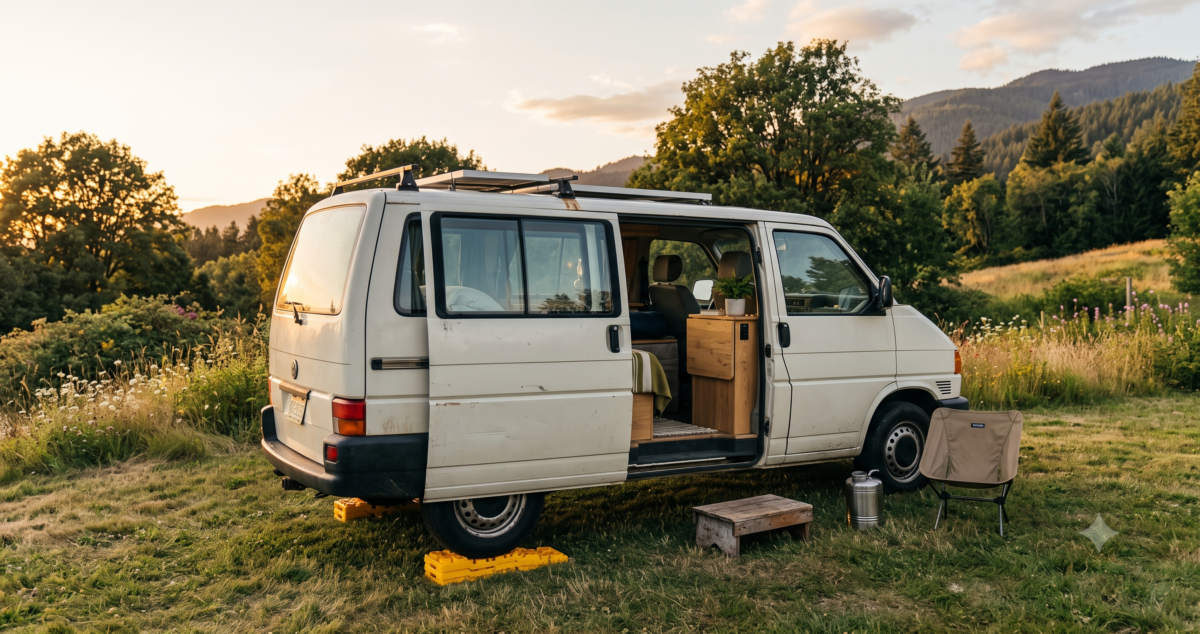
Parking choice affects sleep more than any gear purchase. Level ground comes first — a slope of even a few degrees means sliding toward the low end all night or waking up with blood pooling in your head. Many full-time vanlifers carry a set of levelling ramps for exactly this reason, and it takes under five minutes to check and correct.
Beyond level ground, look for distance from the road, a legal spot, and a read on how bright and noisy the location will be at first light. A cliffside view is a wonderful photo. A flat, quiet, legal pitch is what actually delivers the night’s sleep that makes the photo worth taking.
How Do You Manage Temperature and Condensation in a Van?
Vans heat up fast in direct sun and lose that heat just as fast after dark, because a metal box has almost none of a house’s thermal mass. Two adults breathing in a closed van can fog a cold window within 2-3 hours, and that moisture ends up as damp bedding by morning if it has nowhere to go.
Ventilation fixes most of it
Cracking a roof vent or a window by 1-2 inches lets that moisture escape rather than settle. Pair that with proper insulation in the van’s walls and a sleeping bag rated for the season — 20°F (-6°C) comfort rating covers most shoulder-season trips — and condensation stops being a nightly problem.
How Do You Black Out Van Windows for Total Darkness?
Vans are mostly glass relative to their size, which means first light arrives directly on the bed unless something stops it. Passing headlights do the same thing at 2 a.m. in a busy car park.
Magnetic or suction-mounted thermal blackout screens, cut to each window, solve light, heat retention, and privacy in one pass. A gorgeous parking spot with a bad blackout setup is still a bad night’s sleep. This is one of the few van upgrades that pays for itself on the very first morning it works.
Sleeping through sunrise is a setup problem, not a luck problem
Journo Insiders get The Syndicate’s full trip-prep course, including gear-and-comfort planning for road trips and long-haul travel, as part of the $6,640 in gifts inside the 14-day free trial.
Try Journo Insider free for 14 days →Free for 14 days. Keep your gifts even if you cancel.
How Do You Handle Noise on the Road?
A campervan has close to none of a house’s sound insulation. Rain on a metal roof, wind rocking the van on its suspension, wildlife, and other campers all come through clearly. A pair of foam earplugs rated around 30-33 NRR (noise reduction rating) handles most of it for the cost of a coffee.
Some people find rain and wind genuinely soothing once they know the van is secure. Others wake at every gust. Knowing which type of sleeper you are changes whether earplugs are optional or essential — and choosing a sheltered parking spot cuts down on wind noise before it even starts.
How Do You Choose the Right Van Bedding for Every Season?
Bedding matters more in a van than at home because the temperature swing between afternoon and 3 a.m. is bigger, and the mattress shape is rarely a standard size. Proper fitted sheets cut for the van’s specific mattress dimensions — rather than a standard sheet tucked and re-tucked — stop bedding from bunching up mid-sleep.
Match warmth to the season, not the trip length
A summer trip in a hot climate still needs breathable, lighter bedding for the cold pre-dawn hours. A shoulder-season trip needs a warmer combination even if the daytime temperature hits 70°F (21°C). Packing for the coldest hour of the night, not the warmest hour of the day, is the rule that prevents a 3 a.m. wake-up.
How Do You Feel Safe Enough to Actually Sleep?
Sleep and safety are the same problem wearing different names. A spot that feels wrong — too exposed, too close to a road, too quiet in a way that feels off rather than peaceful — keeps the nervous system half-awake even with a perfect mattress and blackout curtains.
Proper campsites, van life meetup spots, or simply moving on when a location doesn’t feel right all solve this before it becomes a sleep problem. Locking up properly and trusting the initial read on a spot matters more than any single piece of gear on this list.
The Van Sleep Stack: The 5 Layers That Actually Matter
The Van Sleep Stack is the order Operators fix these problems in, because each layer only pays off once the one below it is handled. A perfect mattress on a sloped, noisy, unsafe pitch still fails. A quiet, safe, level pitch with a thin factory pad still fails. The layers compound.
5 Steps to Set Up Your Van for Sleep Tonight
Sleeping well in a campervan comes down to five layers handled in order: a real mattress or topper, a level and quiet parking spot, ventilation against condensation, full blackout for light and heat, and a consistent nightly routine. Skip any layer and the others can’t fully compensate.
Frequently Asked Questions
What is the best mattress upgrade for a campervan?
A 3-4 inch memory foam or latex topper on top of the factory base solves most comfort complaints. For a fixed bed used regularly, a full mattress replacement cut to the van’s exact dimensions is worth the one-time cost.
How do you stop condensation in a campervan overnight?
Crack a roof vent or window 1-2 inches to let moisture escape as you sleep. Combine that with proper insulation and season-appropriate bedding so the inside air doesn’t need to fight the cold metal walls all night.
Do blackout curtains actually help in a van?
Yes. They block dawn light and passing headlights, hold in warmth overnight, and add privacy in car parks or campsites. Fit them tightly against the window frame — gaps at the edges let light back in.
How do you find a quiet, level place to park overnight?
Check the ground with a spirit level or a rolling object, use levelling ramps for anything more than a slight slope, and avoid spots close to roads or exposed to early morning light and noise. A legal, flat, quiet pitch beats a scenic one for actual sleep quality.
What noise reduction rating should campervan earplugs have?
Foam earplugs rated around 30-33 NRR handle most rain, wind, and neighboring-camper noise. Pairing them with a sheltered parking spot reduces wind noise before it reaches the van at all.
How is campervan bedding different from home bedding?
Van mattresses are usually a non-standard shape, so fitted sheets cut to the exact dimensions prevent bunching. Pack for the coldest hour of the night rather than the warmest hour of the day, since temperature swings are sharper in a van than in a house.
Does keeping a routine actually help you sleep in a van?
Yes. A consistent wind-down — same order of small habits before bed — gives the body a familiar signal that night has arrived, even though the parking spot changes constantly. That anchor matters more in a van than at home precisely because everything else is variable.
How do you know if a parking spot is safe enough to sleep in?
Trust the initial read. A spot that feels too exposed or off in some way keeps the nervous system on alert regardless of how comfortable the bed is. Proper campsites or known van life spots remove that variable, and moving on from a spot that feels wrong is never a wasted trip.
Try Journo Insider — keep the gifts no matter what
14 days free. Over $6,640 in travel resources including The Syndicate course, the Exclusives Library, and the Supercharged Travel Fund Challenge. Cancel and keep everything — no questions asked.
Say “maybe” and claim your gifts →Free for 14 days. Cancel anytime — gifts are yours to keep.