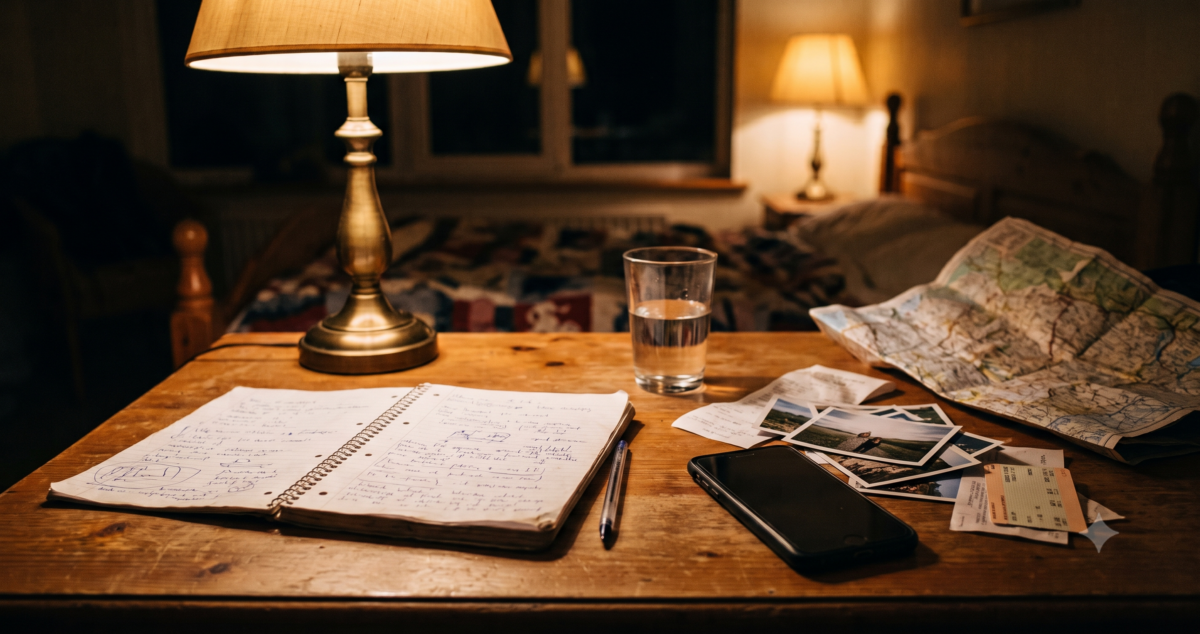
Most people document a trip the same way: a thousand photos on the camera roll, three of them ever looked at again, and no memory of the restaurant’s name, the driver’s story, or the reason that afternoon mattered. Photos capture what a place looked like. They don’t capture what it felt like or what happened. Here’s a system that captures both — and holds up years later, when the details you swore you’d remember have quietly gone.
- Documenting a trip well is a system, not a habit you hope sticks. The system is the CATCH method: Capture in the moment, Anchor to place, Tag the story, Consolidate daily, Hold it forever.
- The failure point is always the same — capturing later instead of now. Details decay within hours.
- Do the five-minute nightly consolidation and you’ll have a complete record; skip it and you’ll have fragments.
- The right app turns the whole system into a few taps and an automatic printed book at the end.
Documenting trips well is one habit of an optimized traveler. Journo Insider is the toolkit behind all of them. Start the 14-day free trial and claim $6,640+ in travel gifts.
Start your free trial Keep everything even if you cancel.Why do most travel records fall apart?
Two failures kill most travel records. The first is deferral: telling yourself you’ll write it up on the flight home, by which point the driver’s name, the dish, and the exact reason a moment landed have all faded. Memory research is blunt about this — specifics decay within hours. The second is fragmentation: photos in one place, notes in another, receipts in a third, so nothing ever assembles into a story.
The fix is a system that captures in the moment and consolidates before the day’s details evaporate. An Operator doesn’t rely on remembering to journal. They run a method.
What is the CATCH method for documenting travel?
CATCH is five moves that turn scattered moments into a durable record. It’s named so you can actually remember it mid-trip.
- Capture in the moment. Log the thing when it happens — a photo plus one sentence of context. Not the view; the sentence. “The owner insisted we try the burnt honey — third time here and he still won’t take money for it.” That sentence is the memory. The photo just proves it happened.
- Anchor to place. Every entry gets a location. Where something happened is half of what makes it findable and re-liveable later. An app that tags location automatically removes the one step people always skip.
- Tag the story, not the scenery. Note who was there, what was said, why it mattered. Scenery is replaceable; the story isn’t. This is the difference between a record you revisit and a folder you don’t.
- Consolidate daily. Five minutes each night: review the day’s captures, add the sentences you didn’t have time for, fill the gaps while they’re still fresh. This single habit is the whole difference between a complete trip and a half-remembered one.
- Hold it forever. Get the finished trip off your phone — a printed book, an owned export, something that survives a lost device and a decade. A record you can’t hold is a record you’ll eventually lose.

Journo captures each moment as an “Adventure,” tags the location automatically, works fully offline for the capture step, and turns the finished trip into a printed book. It’s free and fully unrestricted to try for 14 days, then a subscription from $19.99/month to keep going — the whole CATCH system in one app.
Get Journo on the App StoreHow do you document a trip without it becoming a chore?
The system only works if it’s light. Three rules keep it that way:
Capture in seconds, reflect at night
In the moment, do the absolute minimum — one photo, one sentence. Save the reflection for the nightly five minutes. Front-loading effort mid-day is exactly what makes people quit by day three.

Let the tool do the mechanical parts
Location tagging, offline capture, organizing entries by day — these should be automatic. Every mechanical step you have to do by hand is a step you’ll eventually skip. This is why the app you choose matters: it should carry the friction so you only bring the words.
Decide the ending on day one
Know before you leave how the trip becomes a keepsake. If the answer is “an automatic book,” you’ll capture differently — a little more deliberately — because you know it’s going somewhere. If there’s no ending planned, the record tends to trail off.
The travelers who capture trips well are usually the ones optimizing everything else too — when to book, where to stay, how to stack value. Journo Insider is that whole toolkit. Try it free for 14 days with $6,640+ in gifts.
Start your free trial Keep everything even if you cancel.What should you actually record on each trip?
When you’re not sure what’s worth capturing, default to the things photos can’t hold: the name of the person who helped you, the dish you can’t pronounce but want to find again, the offhand line that made everyone laugh, the reason you changed your plans. Logistics fade fastest and matter most later — the little guesthouse, the bus that only runs Tuesdays, the shortcut a local showed you. Capture those and the trip stays alive. For choosing the app that makes this effortless, see our guide to how to choose a travel journal app, or the full comparison of the best travel journal apps. Once a trip is well-documented, turning it into a printed book is the natural last step.
Journo Insider gives you the full set of Operator systems for traveling smarter and cheaper. Try it free for 14 days with $6,640+ in gifts.
Start your free trial Keep everything even if you cancel.Frequently asked questions
How do you document your travels effectively?
Use a repeatable system rather than hoping you’ll remember. The CATCH method works well: Capture a photo and one sentence in the moment, Anchor each entry to its location, Tag the story rather than the scenery, Consolidate for five minutes each night, and Hold the finished trip as a printed book or owned export. The nightly consolidation is what separates a complete record from fragments.
What’s the best way to journal while traveling?
Capture in seconds during the day and reflect at night. Log one photo and one sentence in the moment, then spend five minutes each evening filling in details while they’re fresh. Use an app that tags location automatically and works offline so the mechanical steps don’t become chores you skip.
Should I use an app or a paper journal to document travel?
Either works if you’re consistent, but an app removes the steps people skip — automatic location tagging, offline capture, and organizing entries by day — and can turn the trip into a printed book automatically. Paper suits reflective writers; an app suits travelers who want a complete record with less manual effort.
How do I remember details from a trip later?
Capture them the same day, before they decay. Specifics like names, dishes, and conversations fade within hours, so the nightly five-minute consolidation is essential. Recording the story behind a moment — not just the photo — is what makes it re-liveable years on.
What app makes documenting travel easiest?
An app that captures in a few taps, tags location automatically, works offline, and exports a finished book. Journo does all four, capturing each trip as an “Adventure” and building it into a printed keepsake automatically — free and fully unrestricted to try for 14 days, then a subscription from $19.99/month.