After all, a beach town with a beautiful café and a 3am stand-up call is a bad month, not a good one. Instead, the places that work for a 30-day stay pass four boring tests first: a legal way to stay, internet you can run a video call on, a monthly cost you can actually predict, and working hours that overlap with your team back home.
Therefore, our picks for the best places for digital nomads in 2026 are Lisbon, Mexico City, Medellín, Buenos Aires and Chiang Mai. Each one is scored below on those four tests, with a real 30-day budget, the season to go and the move experienced remote workers make that first-timers miss. Then pick your US time zone once, and every destination shows where your 9-to-5 lands in local time.
TL;DR: best places for digital nomads 2026
- Five cities pass all four tests (visa, wifi, cost, time zone) for US-based remote workers in 2026: Lisbon, Mexico City, Medellín, Buenos Aires and Chiang Mai.
- Also, a realistic 30-day stay for one person costs $800 to $3,100 before flights, covering a furnished apartment, a coworking desk and food.
- However, time zone is the filter most people skip. Mexico City, Medellín and Buenos Aires keep you on US hours, whereas Chiang Mai puts your workday overnight.
- The Travel Decision Stack (Experience, Real Cost, Timing, Execution) is how to choose, applied here to working, not vacationing.
- Still not sure which fits your job? The Destination Finder matches your dates and travel style to a shortlist.
Journo Insider
Get $6,640 in travel gifts — just for saying “maybe”
Start the 14-day free trial and keep the gifts even if you cancel.
Claim your free gifts →No credit card required. Cancel any time.
What makes a city good for digital nomads?
A good digital nomad city is one where the work part of your month runs as smoothly as it does at home, so the new city gets your evenings and weekends instead of your stress.
In short, it comes down to four things, and we score every destination on them: a visa route that lets you stay legally for 30 days or more, wifi you’d trust with a client call, a 30-day cost for rent, a coworking desk and food, and time-zone overlap with the US. Vibes, sunsets and the café scene matter too, but they come after those four, not before.
How does the Travel Decision Stack apply to remote work?
The Travel Decision Stack, for a working month
- Experience. First, decide what the month is for: a big city with food and culture, a cheap base to save money, or a slower place to focus. “Somewhere nice” is how people end up moving apartments in week two.
- Real Cost. Next, price the month, not the day. A cheap street-food city can still cost more than you think once you add a furnished apartment with real wifi and a desk, as our breakdown of why cheap destinations aren’t cheap explains.
- Timing. In addition, two clocks matter: the season (weather, smoke, rain, crowds) and the time zone. Moreover, shoulder season gets you better rates on monthly rentals; our shoulder season guide for 2026 lists the windows.
- Execution. Finally, sort out visa paperwork, a backup internet line and a 30-day first booking. Then book month one before you commit to month six.
Furthermore, all four layers sit inside the wider Travel Optimization System.
Free Journo tool
Which of these five fits your dates and your job?
The Destination Finder cross-references when you can travel and what you want from the month against timing data for dozens of destinations.
Find your best-fit base →Where is your team?
Each destination below shows where your 9am to 5pm lands in local time today, daylight saving included.
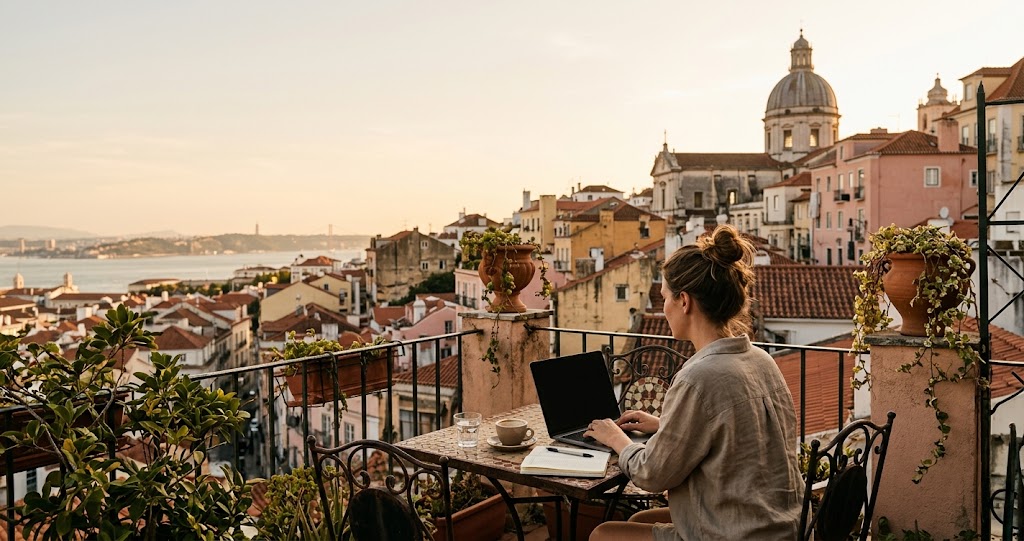
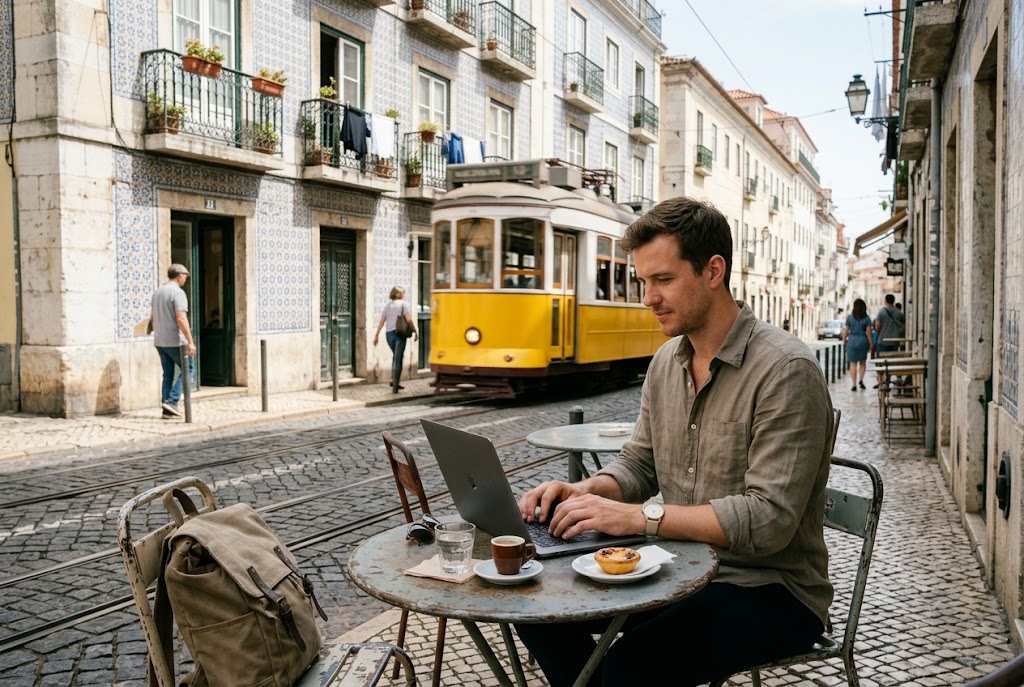
Lisbon, Portugal
First up, Lisbon is the easiest European base for Americans who want a real city, a big remote-work community and the clearest digital nomad visa in Europe. However, the trade-off is cost: it is the most expensive city on this list.
Your US workday in Lisbon
2pm–10pm local time (9am–5pm Eastern) · Afternoons into evenings
The experience in specific terms
Base in Arroios, Graça or Campo de Ourique instead of Baixa or Chiado: real neighborhoods, cheaper rent and fewer hills between you and the coworking space. Mornings are yours, because your US day starts after lunch. Use them for the coast at Cascais, a surf lesson at Carcavelos or a long lunch, then work into the evening.
Visa reality. First, US citizens get 90 days in the Schengen area without a visa. Then, to stay longer, Portugal’s D8 digital nomad visa needs remote income of at least €3,680 a month in 2026 (four times the national minimum wage), per Remote Work Europe. Wifi reality. Fiber is standard in apartments, so 200 to 500 Mbps is normal.
Real cost range
Overall, budget $2,300 to $3,100 for 30 days, before flights. A furnished one-bedroom on a monthly rental runs roughly $1,500 to $2,100, a coworking membership $180 to $280, and food $550 to $750 if you cook some meals. Also, flights from the US East Coast are about 7 hours nonstop.
Rent ~$1,800Desk ~$230Food ~$650≈ $2,680 / 30 days
Timing verdict: April to June, or September to October
It is warm, dry and bright, and monthly rents are also below their summer peak. By contrast, July and August are hot and crowded. Meanwhile, November to February is mild but wet, and many older Lisbon apartments have no central heating, which matters when you sit inside working all day.
Operator tip
Before you pay for a monthly rental, ask the host for a screenshot of a speed test run that week and a photo of the heater. Otherwise, a listing that says “fast wifi” can mean 30 Mbps, and a cold flat in January turns a dream month into a café-hopping month.
Mexico City, Mexico
Next, Mexico City is the best big-city base for remote workers on US hours. In fact, it has world-class food, leafy walkable neighborhoods and a workday that lines up almost perfectly with the US.
Your US workday in Mexico City
7am–3pm local time (9am–5pm Eastern) · Early start, early finish
The experience in specific terms
Live in Roma Norte, Condesa or Juárez, where you can walk to cafés, parks and coworking spaces. Then work an early shift on East Coast time, and you are free by mid-afternoon for markets, museums and late dinners. Then, on weekends, you can reach Teotihuacán, Puebla or Valle de Bravo. Mexico City also makes our list of cities for incredible food and walking, and a month there shows why.
Visa reality. Unlike the others, Mexico has no dedicated digital nomad visa. Instead, most US remote workers enter as visitors, and the officer decides how many days you get, up to 180, so carry an onward ticket and your address. For longer stays, a temporary resident visa needs roughly $4,400 a month in income, per Lorad. Wifi reality. Fiber of 100 to 500 Mbps is common in these neighborhoods, though afternoon storms in the rainy season can cause short outages.
Real cost range
Overall, budget $1,800 to $2,600 for 30 days, before flights. A furnished one-bedroom in Roma or Condesa runs about $1,200 to $1,800 a month, coworking $150 to $220, and food $400 to $600 eating well. Also, flights from most US hubs are 3 to 5 hours.
Rent ~$1,500Desk ~$180Food ~$500≈ $2,180 / 30 days
Timing verdict: late October to April
During this dry season you get sunny days and cool evenings. On the other hand, June to September is the rainy season, with reliable afternoon downpours. It isn’t a dealbreaker; however, plan errands for the morning. Either way, book early for Day of the Dead in late October and for Easter week.
Operator tip
Keep your first three days light. Mexico City sits at about 7,350 feet, and as a result the altitude hits many visitors with headaches, poor sleep and a slower brain. Schedule no big deadlines or presentations until day four, drink more water than you think, and go easy on mezcal the first weekend.

Flying home every few months? The Syndicate shows how Operators cover those flights with points instead of cash.
Try Journo Insider free for 14 days →Medellín, Colombia
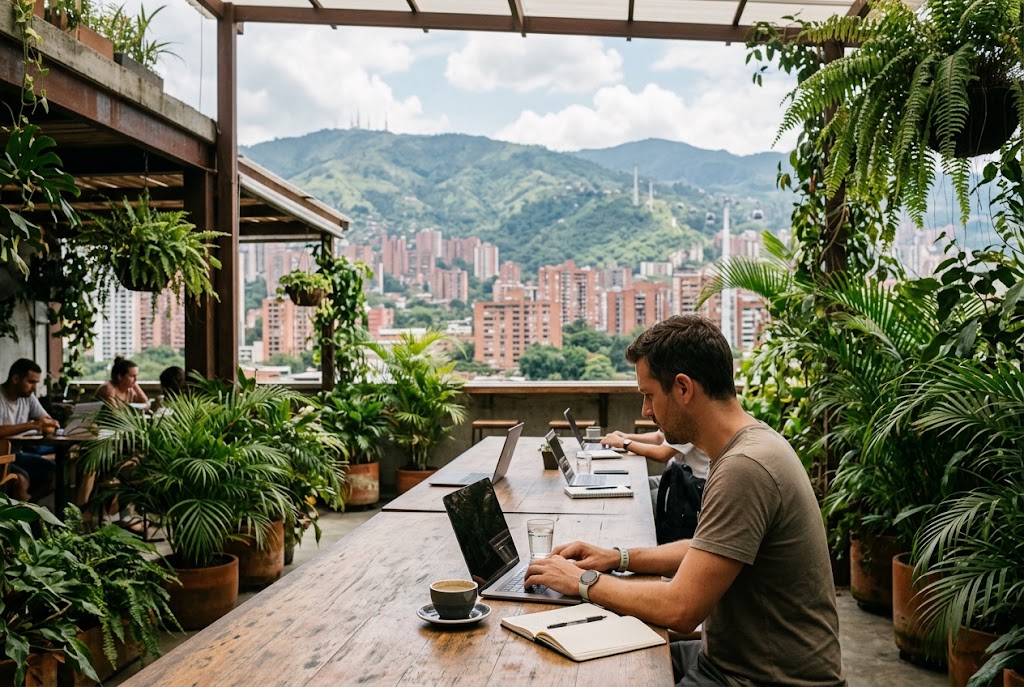
Similarly, Medellín is the all-rounder: spring weather all year, a clear digital nomad visa with a low income bar, US working hours and a monthly cost well under Mexico City’s.
Your US workday in Medellín
8am–4pm local time (9am–5pm Eastern) · Fully in sync
The experience in specific terms
Stay in Laureles for a local, walkable neighborhood with better value, or in El Poblado for the most coworking spaces and nightlife. Meanwhile, the metro and cable cars make the city easy to explore after work, and weekend trips to Guatapé and the coffee towns are a short drive away.
Visa reality. First, US citizens get up to 90 days on arrival, extendable to 180 days a year. Then, for longer stays, Colombia’s digital nomad visa, valid for up to two years, asks for monthly income of three times the minimum wage: COP 5,252,715, or roughly $1,640, in 2026, per Colombia Move. Wifi reality. Fiber of 100 to 300 Mbps is common in newer buildings; older ones can be much slower, so ask.
Real cost range
Overall, budget $1,200 to $1,800 for 30 days, before flights. A furnished one-bedroom in Laureles or El Poblado is about $750 to $1,200 a month, coworking $100 to $160, and food $350 to $450. Also, nonstop flights from Miami, Fort Lauderdale and New York take about 3 to 5.5 hours.
Rent ~$950Desk ~$130Food ~$400≈ $1,480 / 30 days
Timing verdict: December to March, or June to August
Medellín is around 70 to 80°F all year; therefore, the season is about rain, not heat. These are the drier stretches, whereas April to May and October to November bring the most rain. Early August is the Flower Festival: fun, but book your apartment early.
Operator tip
Never invite a dating-app match back to your apartment, especially in your first weeks. That is because the US Embassy in Bogotá has repeatedly warned about foreigners being drugged and robbed this way in Medellín. Meet in busy public places, use ride-hailing apps instead of street taxis at night, and keep your laptop out of sight on the street.
Buenos Aires, Argentina
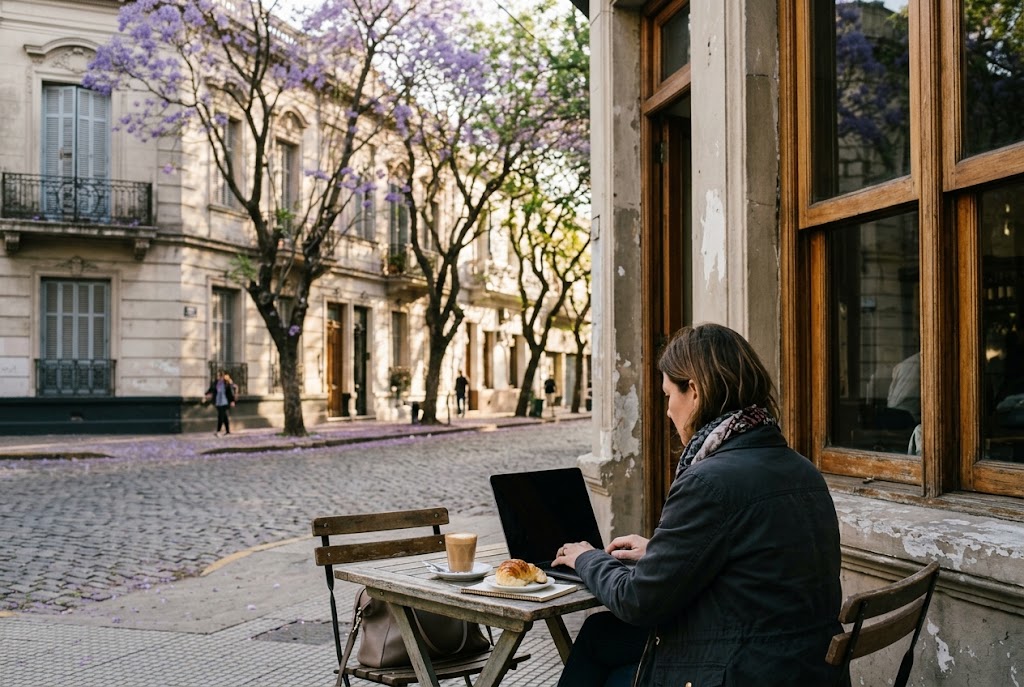
Likewise, Buenos Aires gives you the feel of a European capital on Americas hours, with tree-lined streets, late dinners and a café on every corner, one to two hours ahead of New York.
Your US workday in Buenos Aires
10am–6pm local time (9am–5pm Eastern) · Fully in sync
The experience in specific terms
Base in Palermo (Soho or Hollywood) for coworking and cafés, or Recoleta for quieter, grander streets. The city runs late: dinner at 9:30pm is normal, which suits a US workday perfectly. Then weekends are for the San Telmo market on Sunday, a ferry across to Colonia in Uruguay, or a tango class.
Visa reality. First, US citizens get 90 days on arrival. Then Argentina’s digital nomad residence gives up to 180 days, extendable once, and has no fixed minimum income; you show contracts or invoices from clients outside Argentina, per Expats Argentina. Wifi reality. Similarly, fiber of 100 to 300 Mbps is widely available in Palermo and Recoleta. Summer heat waves can cause power cuts, so a coworking space is your backup.
Real cost range
Overall, budget $1,350 to $2,000 for 30 days, before flights. A furnished one-bedroom in Palermo runs about $800 to $1,200 a month, coworking $120 to $180, and food $400 to $600. Argentina is no longer the bargain it was a few years ago, and prices move fast, which is exactly why the daily price isn’t the real cost. Flights from the US East Coast, however, are about 10.5 to 11 hours overnight.
Rent ~$1,000Desk ~$150Food ~$500≈ $1,650 / 30 days
Timing verdict: March to May, or September to November
Southern Hemisphere autumn and spring: mild days, jacaranda trees in bloom in November, and the city at full speed. By contrast, January is hot and many locals leave town; June to August is gray and chilly but cheaper.
Operator tip
Pay by card instead of carrying stacks of dollars to exchange. That is because foreign Visa and Mastercard payments now get a rate close to the market rate, so the old “blue dollar” cash routine rarely pays off. Also, use a card with no foreign transaction fee, and keep a small cash reserve for the places that don’t take cards.
Chiang Mai, Thailand
Finally, Chiang Mai is the cheapest and calmest base on this list, with fast wifi, a five-year visa built for remote workers and great food. The catch is the clock: your US workday lands in the middle of the night.
Your US workday in Chiang Mai
8pm–4am local time (9am–5pm Eastern) · Night shift (go async)
The experience in specific terms
For the best base, stay around Nimman or inside the Old City moat. Then work your deep-focus hours in the day, take US calls in the evening, and keep weekends for Doi Suthep, the night markets and the mountain loop to Pai. Therefore, it suits people whose jobs are mostly asynchronous: writers, developers, designers and anyone who can answer messages overnight.
Visa reality. The Destination Thailand Visa (DTV) is a five-year multiple-entry visa allowing 180 days per entry, extendable once by 180 days. However, it needs 500,000 baht (about $15,000) in savings and a 10,000-baht fee, per The Thaiger. Wifi reality. On top of that, home fiber of 500 Mbps to 1 Gbps is cheap and common, and the best on this list.
Real cost range
Overall, budget $800 to $1,200 for 30 days, before flights. A furnished studio or one-bedroom in Nimman runs about $400 to $700 a month, coworking $80 to $120, and food $250 to $350 eating mostly local. Still, getting there is the expensive part: about 20 to 24 hours from the US with a connection, and $900 to $1,500 round trip.
Rent ~$550Desk ~$100Food ~$300≈ $950 / 30 days
Timing verdict: November to January
Cool, dry and clear: the best weather of the year. However, from roughly late February to April, crop burning fills the valley with smoke and air quality is often among the worst in the world. May to October is hot and rainy but green and cheap.
Operator tip
If you stay past February, book your smoke escape before you arrive. Plan to spend March and April on a Thai island such as Koh Lanta or Koh Phangan, where the air is clean. Your DTV covers you anywhere in Thailand, so you only change apartments, not visas.
How do the best places for digital nomads in 2026 compare?
For example, here is the side-by-side for one person on a 30-day stay, with times for a US Eastern workday in October.
| Destination | Visa route | 30 days (solo) | Wifi | 9am Eastern is | Best window |
|---|---|---|---|---|---|
| Lisbon | D8 visa, €3,680/month income | $2,300–$3,100 | 200–500 Mbps fiber | 2pm | Apr–Jun; Sep–Oct |
| Mexico City | Visitor stay (no nomad visa) | $1,800–$2,600 | 100–500 Mbps fiber | 7am | Late Oct–Apr |
| Medellín | Nomad visa, ~$1,640/month income | $1,200–$1,800 | 100–300 Mbps fiber | 8am | Dec–Mar; Jun–Aug |
| Buenos Aires | Nomad residence, 180 days | $1,350–$2,000 | 100–300 Mbps fiber | 10am | Mar–May; Sep–Nov |
| Chiang Mai | DTV, 500,000 baht savings | $800–$1,200 | 500 Mbps–1 Gbps fiber | 8pm | Nov–Jan |
Most first-time nomads pick the city and then find out the hours. Operators pick the hours and then find the city.
How do you choose the right base for your job?
- Start with your calendar. First, count your live meetings in a normal week. More than a few a day? Stay on Americas time: Mexico City, Medellín or Buenos Aires. Mostly async? In that case, Lisbon and Chiang Mai open up too.
- Check the visa against your income and dates. A 30-day trip needs no special visa in any of these five. However, a 3-month-plus stay does, and the income bars range from about $1,640 a month in Colombia to €3,680 in Portugal.
- Budget the month, not the day. In other words, add rent, a desk, food and one flight home. If the total feels tight, our guide to the true cost of travel shows where the hidden costs hide.
- Book 30 days, then decide. Lock in one month somewhere you can test the wifi, the neighborhood and your routine before you commit to longer. Then check your shortlist in the Destination Finder to see which of the best places for digital nomads in 2026 fits your dates.
Quick answer
The best places for digital nomads in 2026 are Lisbon (D8 visa, about $2,300 to $3,100 a month), Mexico City (US hours, $1,800 to $2,600), Medellín (easiest nomad visa, $1,200 to $1,800), Buenos Aires (European feel on Americas time, $1,350 to $2,000) and Chiang Mai (cheapest and fastest wifi, $800 to $1,200, but overnight US hours). If you need live meetings with a US team, choose one of the three Latin American cities.Try Journo Insider — keep the gifts no matter what
Say “maybe” and claim your gifts →Frequently asked questions about the best places for digital nomads
What is the best place for digital nomads in 2026?
Of the best places for digital nomads in 2026, Medellín is the strongest all-rounder for Americans: US working hours, spring weather all year, a digital nomad visa with a low income requirement (about $1,640 a month) and a 30-day cost of roughly $1,200 to $1,800. Meanwhile, Lisbon is the best pick in Europe if your income clears Portugal’s D8 bar.
Which countries have a digital nomad visa?
Of the five on this list, Portugal (D8), Colombia, Argentina and Thailand (the DTV) all have visas or residence permits designed for remote workers. Mexico does not have one, so most remote workers enter as visitors or apply for temporary residency, which has a much higher income requirement.
What is the cheapest city for digital nomads?
Chiang Mai, at about $800 to $1,200 for 30 days, covering rent, a coworking desk and food. Meanwhile, in the Americas, Medellín is the cheapest at about $1,200 to $1,800. Remember to add flights: reaching Thailand from the US costs far more than Colombia.
Which digital nomad cities are best for working US hours?
Medellín, Mexico City and Buenos Aires. Medellín is on Eastern time in winter and one hour behind in summer, Mexico City is one to two hours behind, and Buenos Aires is one to two hours ahead. In Lisbon, a US workday runs from mid-afternoon to late evening, and in Chiang Mai it runs overnight.
Do I need a digital nomad visa for a one-month stay?
Usually not, because US citizens can visit all five of these countries for at least 30 days without a visa, and most people working remotely for a US employer on a short trip do so as visitors. For stays of three months or more, or if you want to be fully covered, apply for the country’s nomad visa. Check taxes with an accountant before you stay abroad for long.
After all, the best office view in the world is worthless at 3am. Choose the hours first, and the city will do the rest.