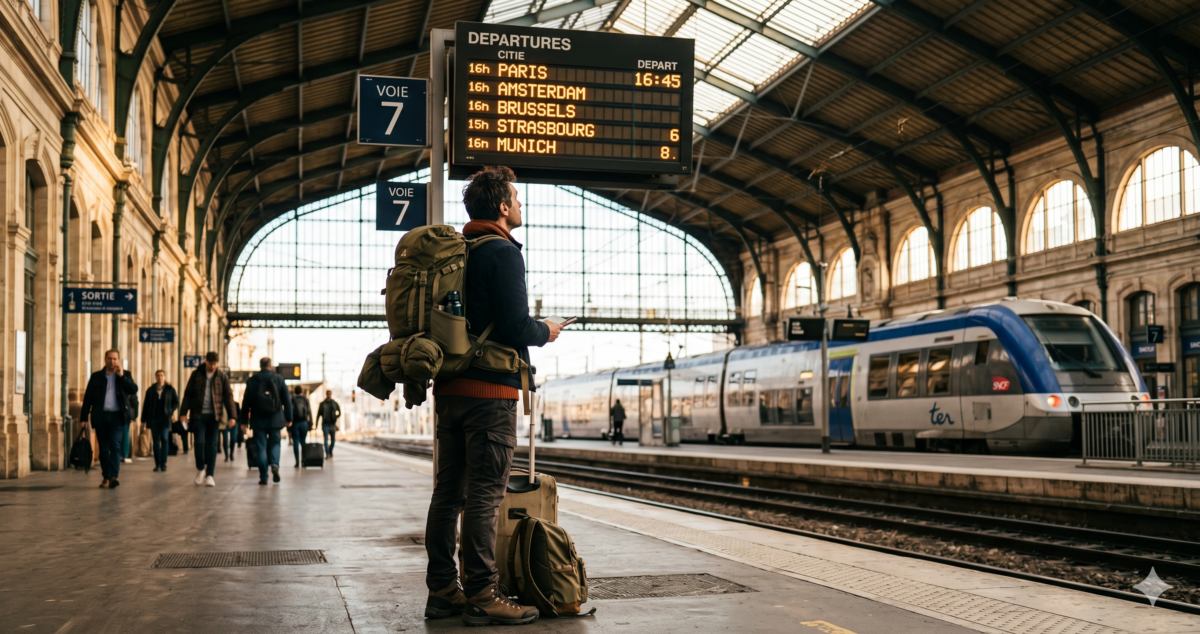
The choice between solo and group travel isn’t about personality. It’s about what you’re trying to extract from a trip — and whether your travel structure can actually deliver it. This framework maps the decision to outcomes, not preferences.
- Solo travel costs 30–40% more per person than group travel at equivalent standards.
- Group travel is not slower — it’s structurally different. Logistics multiply, but so does value compression.
- The Travel Decision Stack has four layers: Experience → Real Cost → Timing → Execution. Run the decision through all four before you book.
- Most travelers choose solo or group based on habit, not analysis. That’s the gap Operators close.
- Neither mode is better. The wrong mode for the right destination still produces a bad trip.
Try Journo Insider today and unlock The Syndicate 7-week travel course ($899), the Insiders Exclusive Library ($1,337), the Supercharged Travel Fund Challenge ($3,600), and more — free for 14 days. Keep the gifts even if you cancel.
Claim your free gifts →Keep everything even if you cancel.
What is the Travel Decision Stack?
The Travel Decision Stack is Journo’s four-layer framework for making high-stakes trip decisions without defaulting to habit or gut feeling.
The four layers, in order: Experience → Real Cost → Timing → Execution.
Most travelers start at Execution. They decide where they want to go, then figure out how to get there. The result is trips that look good on paper and feel compromised in practice. Operators run the stack from the top down — they define the experience they’re after first, then select the travel structure that can actually produce it.
The Travel Decision Stack applied to group size doesn’t ask “do I prefer solo or group travel?” It asks: “Which structure produces the experience I’m actually trying to have?” Those are different questions. One is about identity. The other is about outcomes.
Solo versus group is a structure question, not a personality question. The stack helps you separate what you think you want from what the data says you’ll get.
What does solo vs group travel actually cost?
The solo tax is real and consistently underestimated. Solo travelers pay a single supplement — usually 50–100% of the double-occupancy rate — on cruises, tours, and many hotel bookings. For a 10-night Europe trip at mid-range hotels averaging $180 per room, a solo traveler pays $1,800. Two people splitting that same room pay $900 each. The experience is identical. The cost delta is $900.
Where solo travel costs more
Accommodation is the largest cost gap. Most hotel pricing assumes two guests per room. A group of four splits costs across two rooms instead of four. Private tours, hired guides, and private transfers are fixed costs that don’t scale down for one person. A private airport transfer that costs $65 for a group of four costs $65 for a solo traveler — the same money, zero scale.
For dining, solo travelers pay the same menu prices but often can’t access table minimums at higher-end restaurants. Group travelers split bottles of wine, share tasting menus, and unlock per-person minimums that bring the per-head cost down significantly.
Where group travel costs more
Group travel has its own cost amplifiers. Consensus is expensive. When four people can’t agree on a restaurant, someone ends up at a place nobody really wanted. Decision friction across a multi-city itinerary can easily add a day’s worth of unplanned expenses — extra nights, changed bookings, transport gaps.
Group flights are also harder to optimize. A solo traveler books the exact seat, the exact flight, the exact routing that maximizes their points value. A group of four, however, needs four adjacent seats on the same flight. That constraint limits sweet spots significantly. Award availability on many routes drops sharply for 4+ passengers — especially in business class.

What’s the experience difference — really?
Solo travel maximizes optionality. You move when you want, stay longer at the thing that unexpectedly captivates you, and leave the place that disappoints without asking anyone. There is no negotiation, no calendar conflict, no compromise. The daily rhythm is entirely yours.
Solo travel gives you the trip you design. Group travel gives you a trip you couldn’t have designed alone.
Group travel compresses what’s possible. A well-matched group notices more than one person does — because there’s always someone looking at the thing you walked past. The collective result is a trip that couldn’t have been designed in advance by any one of them.
In practice, the failure mode for solo travel is isolation. Two weeks alone in a country where you don’t speak the language can shift from freedom to loneliness faster than most solo travelers predict. The failure mode for group travel, by contrast, is friction. The wrong group configuration — mismatched pace, mismatched budget, mismatched expectations — produces a trip that’s worse than traveling alone.
The 7-week Syndicate course inside Journo Insider maps every major travel decision to an Operator framework: group configuration, points strategy, timing, and execution. Most travelers never see these decisions as a system. Operators do. Try Journo Insider free for 14 days.
Try Journo Insider free for 14 days →Free for 14 days. Keep your gifts even if you cancel.
Solo vs group travel: how do they actually compare?
| Dimension | Solo Travel | Group Travel (2–4 people) |
|---|---|---|
| Accommodation cost | Full room rate; single supplement of 50–100% common | Shared per-room cost; 2 sharing cuts per-person spend by ~50% |
| Transport flexibility | Maximum — book any flight, any seat, any time | Constrained by group size; award availability drops for 4+ seats |
| Itinerary control | Complete — pivot at any moment, no consensus required | Shared — every change requires alignment; friction increases with group size |
| Points optimization | High — solo seats easier to find on sweet spot routes | Moderate — 2 seats easier than 4; direct transfers often needed |
| Experience depth | Deep but narrow — you see what you notice | Broader — group members surface things solo travelers miss |
| Dining access | Limited at table-minimum venues; single meals often overpriced | Better access to tasting menus and shared formats; lower per-head cost |
| Logistics complexity | Low — one person, one bag, one decision | High — scales roughly with group size; transfers, check-in, pacing all multiply |
| Failure mode | Isolation and loneliness on longer trips | Friction from mismatched expectations or budgets |
| Best suited for | Urban exploration, spontaneous trips, self-directed learning travel | Beach destinations, celebration trips, destinations with high fixed-cost experiences |
How do you run the Travel Decision Stack on your next trip?
Four steps. In order. Don’t skip to step four.
What is this trip actually for? Write one sentence. Not “see Portugal” — something specific: “Three weeks of slow, unhurried exploration with full daily freedom” or “A milestone birthday with the four people who matter most.” The sentence determines everything below it. If the sentence is vague, the trip will be vague.
Once you have that sentence, price the trip both ways before committing. Get a solo cost and a group cost for the same standard of accommodation, transport, and dining. Most people are surprised by the gap. The solo premium on a 12-night trip averaging $200/night is $2,400 compared to a pair splitting the same rooms — that’s real money that could fund another trip.
Even when cost works out, timing can break the decision. Group travel requires more lead time. Coordinating four schedules across a 10-day window takes months, not weeks. Shoulder season trips — typically April–May or September–October — are easier to fill a group calendar around than school holidays or peak summer. If the trip has a timing constraint, check whether the group configuration can actually hit that window before proceeding.
For solo: identify the one leg of the trip most likely to feel isolating and build a social anchor into it — a cooking class, a guided day, a meetup. For group: identify the one decision most likely to create friction (restaurant selection, daily pace, budget ceiling) and resolve it before departure, not during the trip. Most group travel friction is predictable. Operators pre-empt it.
For first-time solo travelers, the right starting point isn’t the most ambitious destination — it’s the one with the highest density of structured social experience. See the full guide on where to travel solo for the first time for destination-specific applications of this framework.
When does the framework say solo? When does it say group?
Solo wins when
The experience you want requires daily optionality. You don’t know exactly what you want from the trip yet. The destination rewards slow exploration over checked-off landmarks. Your travel calendar is more flexible than anyone else’s. Or you’re optimizing for points redemptions on specific award space that only exists for one or two seats.
Group wins when
The experience is inherently shared — a celebration, a family milestone, a destination that’s better with witnesses. Fixed-cost experiences (safari, private villa, multi-day expedition) distribute across the group and make the per-person cost dramatically lower than solo. The group has compatible pace and budget expectations. Or the destination is one where you genuinely benefit from other people surfacing what you’d miss alone.
Before booking any multi-person trip, run the Regret-Free Trip Audit — seven questions that stress-test a trip decision before money moves. One of those questions specifically addresses group compatibility. Most trip regrets are predictable before departure. This audit makes them visible.
What about families?
For families with children, the framework works differently. Group size isn’t a choice — it’s a fixed constraint. In that case, skip layer one of the stack and start directly at real cost. The Family Travel Decision Stack covers how to apply the framework when group configuration isn’t negotiable.
Solo travel costs 30–40% more per person at equivalent accommodation standards but delivers full itinerary control. Group travel reduces per-person costs, unlocks shared experiences, and scales down fixed-cost activities — but adds logistics complexity and requires pre-aligned expectations. The Travel Decision Stack resolves the choice in four steps: define the experience you want, calculate real costs both ways, check timing compatibility, and stress-test execution before booking.
Frequently asked questions about solo vs group travel
For most trip types, yes — by 30–40% at equivalent standards. The biggest cost drivers are accommodation (solo travelers pay full room rates, often with a single supplement), private transport (fixed costs don’t scale down), and high-end dining (table minimums and shared formats favor groups). The gap is narrowest in destinations with cheap, abundant private accommodation like Southeast Asia or Central America.
It can. Award space for four passengers on the same flight in the same cabin is meaningfully harder to find than space for one or two. For groups of two, the constraint is minor — most sweet spots have availability for two seats. For groups of four or more, you’ll often need to split into two bookings or adjust the routing. Factor this into the real cost layer of the Decision Stack before committing to a group configuration.
Two travelers hit the best balance of shared cost, logistics simplicity, and flexibility. Groups of four work well for villa-style or resort travel where fixed costs divide evenly and private transport makes sense. Above six, logistics complexity typically outweighs cost savings for most trip types. Groups larger than eight almost always require a dedicated tour operator to manage execution.
Resolve it before departure, not during. The highest-friction scenario in group travel is a member with a materially different spending ceiling discovering that fact mid-trip. Before booking, set explicit per-day budget expectations for accommodation, dining, and activities. If there’s a 2× gap between the highest and lowest spender in the group, the structure needs to change — or the group does.
More questions about solo and group travel
Yes, and it’s more common than most solo travel content acknowledges. The risk increases on trips longer than 10 days, in destinations where language barriers are high, and when the itinerary has few structured social anchors. The fix isn’t to travel with someone — it’s to design social entry points into the itinerary: a multi-day group tour, a cooking class, a language exchange. Operators pre-build these anchors before departure.
Assuming shared enthusiasm means shared expectations. Four people who all say “yes” to a trip to Japan may have four completely different visions of what that trip looks like — one wants museums, one wants nightlife, one wants nature, one wants high-end dining. The assumption of alignment, untested before departure, is where most group travel friction originates. A single 30-minute pre-trip conversation about daily priorities prevents most of it.
Urban, walkable, English-friendly cities with dense cultural programming are highest-value for solo travelers — Tokyo, Lisbon, Copenhagen, Buenos Aires. These destinations reward the freedom to move at your own pace and have high concentrations of solo-friendly experiences. Remote adventure travel and celebration-style resort destinations, by contrast, tend to produce the least value for solo travelers relative to their cost.
When group configuration isn’t negotiable — family travel, milestone trips with a set guest list — skip layer one of the stack and begin at the real cost layer. The question shifts from “should I travel solo or in a group” to “what type of trip does this group configuration optimize for.” Fixed-cost experiences (private villas, multi-day itineraries, safari camps) become more attractive as group size increases. Per-person costs drop significantly, and the group starts to function as a leverage multiplier.
14 days free. Over $6,640 in travel resources including The Syndicate course, the Exclusives Library, and the Supercharged Travel Fund Challenge. Cancel and keep everything — no questions asked.
Say “maybe” and claim your gifts →Free for 14 days. Cancel anytime — gifts are yours to keep.
Last updated June 2026