
Saudi Arabia’s travel market is thriving, powered by near-universal internet access and a fast growing culture of mobile-first trip planning.
More travelers are researching, comparing, and booking entire trips from their phones, making travel one of the more active app categories in the region.
Exact download rankings for travel apps change constantly and aren’t something any single source can verify with certainty, since app stores don’t publish official download counts and third-party estimates vary widely.
What is measurable is which categories of travel apps are seeing the fastest growth, and why.
This article looks at what’s actually driving downloads across the market, rather than guessing at a single winner.
TL;DR: travel apps in Saudi Arabia
- No public, verified ranking of the most downloaded travel apps in Saudi Arabia exists, because app stores don’t publish official download counts.
- Demand is real: 99% of people aged 15 to 74 use the internet, and Saudi airports handled 140.9 million passengers in 2025.
- Five categories pull most downloads: all-in-one booking apps, airline apps, hotel apps, ride-hailing apps and Hajj and Umrah service apps.
- Downloads spike around Umrah, Hajj, Eid, summer holidays, flash sales and BNPL payment options.
- Retention matters more than installs. Fast rebooking, loyalty perks and a real Arabic and English experience keep an app on the phone.
Journo Insider
Get $6,640 in travel gifts — just for saying “maybe”
Start the 14-day free trial and keep the gifts even if you cancel.
Claim your free gifts →No credit card required. Cancel any time.
Saudi Arabia’s Mobile-First Travel Market
According to a report from TechAfrica News, Saudi Arabia has one of the highest rates of mobile internet use in the world. As of early 2026, internet usage across the Kingdom reached 99% among people aged 15 to 74. That level of connectivity means mobile is increasingly the default channel for research, comparison, and booking, not just browsing.
For travel specifically, this shift shows up clearly in the numbers. Saudi airports handled about 140.9 million passengers in 2025, up 9.6% year on year, with domestic travelers reaching 65.1 million, a 9.8% increase, as stated by Arab News. More trips, booked and managed on more phones, naturally translates into more app downloads.
Categories of Travel Apps Driving Download Volume
Rather than one dominant download leader, a handful of categories generally account for most travel-app activity in the Kingdom, each pulling downloads for a different reason:
OTA and aggregator apps
Combine flights, hotels, and car rentals in one place.
Airline-specific apps
Used mainly for check-in, boarding passes, and loyalty programs.
Hotel-chain apps
Used for direct bookings and loyalty perks.
Ride-hailing and local transport apps
Often downloaded alongside travel apps for the same trip.
Government and religious-travel service apps
Used specifically for Hajj and Umrah logistics.
Each category serves a different moment in the trip, which is part of why no single app tends to dominate every use case.
Operator tip
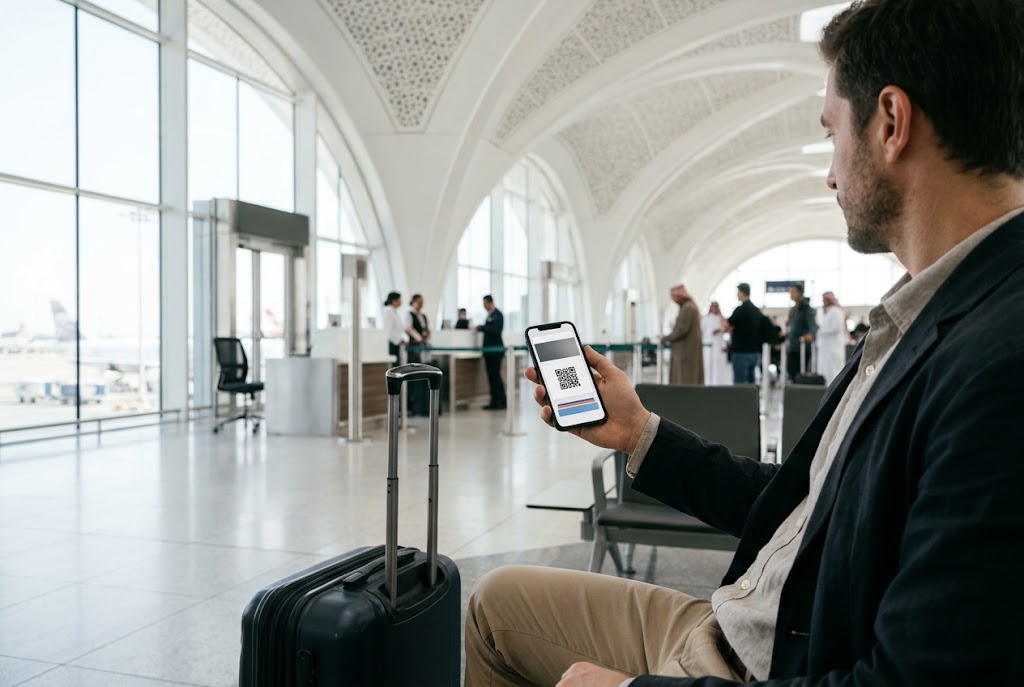
Before you fly, install your airline’s app and one ride-hailing app, sign in, and add a payment card while you are still on home Wi-Fi. Then, when you land, check-in, boarding passes and your first ride from the airport all work in a minute, without a verification code arriving on a SIM you have already swapped out.
The right app gets you the booking. The Syndicate shows how Operators pay for the flight itself with points instead of cash.
Try Journo Insider free for 14 days →What Drives Download Spikes: Seasonal and Behavioral Triggers
Downloads for travel apps in Saudi Arabia rarely grow at a steady, predictable pace. Instead, they spike around specific events and windows:
Umrah season
Umrah season brought more than 15 million pilgrims to the Kingdom in the first quarter of 2025 alone.
Hajj season
Hajj season, with just over 1.7 million pilgrims recorded in 2026, most arriving from abroad.
Eid and summer
Eid and summer school-holiday travel windows.
Flash sales
Flash sales and limited-time price drops, which prompt install-to-book behavior.
Split payments
The option to split payments through BNPL providers such as Tabby and Tamara, which can lower the barrier to completing a booking on the spot.
These spikes tend to be short and concentrated, which is part of why raw download numbers can be misleading without looking at what happens afterward.
Where These Trends Show Up in Practice
Full-service platforms that let travelers handle an entire trip without switching apps are one category seeing steadier download activity.
For instance, Almosafer, a full service platform in this space, has passed well over 1 million downloads on Google Play and holds a 4.7 rating across both iOS and Android app stores from tens of thousands of reviews.
This is also because it covers flights, hotels, and activities such as tours and local experiences within a single app, alongside car rentals, airport transfers, and alternative stays such as chalets. This is significant for app retention because users do not need to switch between multiple platforms and plan their itinerary within one app.
Its loyalty integrations span more than one scheme:
- Points can be earned or redeemed through Qitaf.
- STC’s loyalty programme.
- Mokafaa, another widely used Saudi rewards platform.
- Travelers with a frequent flyer membership on a major national carrier can earn miles on eligible bookings.
- Almosafer’s own wallet credits a portion of every purchase toward future trips.
All of this shows how the all-in-one category described above plays out on an app people are actually installing.
Downloads vs. Retention: Why Being Installed Isn’t the Whole Story
A download is not the same as a kept app. Many travelers install a travel app for a single booking; once the trip is done, the app may sit unused or get deleted, especially on budget phones with limited storage.
What tends to keep a travel app installed long-term:
- Fast, in-app rebooking or cancellation, without needing to call anyone.
- Price alerts or loyalty perks that give a reason to open the app between trips.
- A genuinely bilingual Arabic and English experience, rather than a translated afterthought. Almosafer, for instance, runs its booking flow in both languages rather than treating Arabic as a secondary option.
Retention is a better long-term signal than raw downloads, since it reflects whether an app earned a permanent spot on someone’s phone rather than a one-time booking.
Keep or delete? Check a travel app on your phone
Pick a travel app you installed for your last trip and tap everything it does. The meter shows how likely it is to earn a permanent spot on your home screen.
0 of 5 Tap what your app does.
Operator tip
After a trip, give each new travel app one honest test: did you open it more than once? If it holds your points, your wallet credit or a booking you might need to change, keep it and turn on price alerts for your next route. If it only did one booking, delete it and keep the storage for the apps that pay you back.

Quick Snapshot—Factors Behind Growing Travel App Downloads
- 99% internet penetration in Saudi Arabia as of early 2026, almost entirely via mobile.
- 140.9 million airport passengers in 2025, up 9.6% year on year.
- More than 15 million Umrah pilgrims recorded in the first quarter of 2025 alone, with volumes staying strong into 2026.
- As reported by Arab News, 76 SAMA-licensed finance companies are now supporting BNPL and consumer finance options in the Kingdom.
Conclusion
There isn’t a single most-downloaded travel app in Saudi Arabia that anyone can state with certainty, since that data simply isn’t published for public verification. What is clear is which categories are driving growth: combined booking apps, airline and hotel apps, and religious-travel tools, all pushed along by near-universal mobile use and predictable seasonal spikes.
Which one stays installed long after the trip ends tends to depend more on everyday convenience and language support than on the download number itself.
Quick answer
No verified public ranking of the most downloaded travel apps in Saudi Arabia exists, because app stores don’t publish official download counts. The categories with the most activity are all-in-one flight and hotel booking apps, airline apps, hotel-chain apps, ride-hailing apps and Hajj and Umrah service apps, driven by 99% internet use, 140.9 million airport passengers in 2025 and seasonal spikes.Journo Insider
Book smarter on any app, and keep $6,640 in travel gifts
Try Journo Insider free for 14 days. Keep the gifts even if you cancel.
Say “maybe” and claim your gifts →FAQs
Which travel app has the most downloads in Saudi Arabia?
No single verified public ranking exists, since app stores don’t publish official download counts and third-party trackers vary widely. What’s measurable is which categories, such as combined flight-and-hotel apps, see the most consistent activity.
Are Hajj and Umrah apps among the most downloaded in Saudi Arabia?
Religious-travel service apps see sharp, short-lived download spikes tied to Hajj and Umrah seasons, when millions of pilgrims travel to the Kingdom within a short window each year.
What makes travelers keep a travel app installed after booking?
Fast in-app rebooking, price alerts, loyalty perks, and a properly bilingual experience are the features most linked to travelers keeping an app installed rather than deleting it after a single trip.
Disclaimer: Data validated in October 2026. All values are subject to real-time changes.