
Travel currency tips usually stop at “check the rate before you go,” which misses where the money actually leaks. The best travel currency tips are about avoiding the four ways travelers quietly lose 5 to 15 percent of their money on every conversion: airport counters, DCC prompts, the wrong card, and fees nobody checked in advance.
- Airport currency exchange counters mark up rates 5–15% above the real mid-market rate — use them only for emergency cash, never a full trip’s budget.
- The “pay in your home currency” prompt at foreign card terminals, called dynamic currency conversion, adds another 2–7% on top of whatever your card already charges. Always decline it.
- A no-foreign-fee card saves the 1–3% (roughly 1.5% average) that most cards quietly charge on every purchase abroad.
- The named framework here: the CHANGE Method — six habits that close the leaks, in order.
- The honest rule: the rate you see online and the rate you actually get are rarely the same number, and the gap between them is where a travel budget quietly disappears.
Why do travelers lose money on currency without realizing it?
Nobody loses money on currency in one dramatic moment. It happens in small, repeated decisions: the “pay in dollars” button tapped without reading it, the airport kiosk used because the line was short, the card that charges 3% on every purchase because nobody checked before the trip. None of these feel expensive individually. Stacked across a two-week trip, they routinely cost travelers 5 to 8% of their total spend — real money that never shows up as a single line item, so it never gets noticed.
The fix isn’t finding one perfect exchange rate. It’s a short list of habits that close each leak before it opens.
The CHANGE Method
Six moves, in the order they matter most, adapted from Journo’s tool-evaluation framework for the specific job of not losing money on currency:
- Check the real rate before you go. Look up the mid-market rate — the actual number banks trade at, with no markup — using a converter app or a quick search. This is the number every offer you see abroad should be measured against, not the number the exchange counter shows you.
- Hold a card with no foreign transaction fee. Most cards charge 1–3% on every purchase processed outside your home country, averaging around 1.5% in 2026. A no-foreign-fee card erases that cost entirely and pays for itself within the first few purchases of a trip.
- Avoid DCC and airport counters. When a foreign terminal asks “pay in dollars or local currency,” always choose local currency — the dollar option is dynamic currency conversion, and it adds 2–7% on top of whatever your card already charges. Airport exchange counters are worse: 5–15% above the real rate, reserved for emergency cash only.
- Need no signal, no problem. The best moments to check a fair price are exactly the moments you have no WiFi — a market stall, a taxi, a border crossing. An offline-capable converter means “I don’t have signal” is never the reason you overpaid.
- Guard against ATM surprises. Withdrawing cash abroad can stack your card’s own foreign transaction fee with a flat operator fee, typically $2–5 per withdrawal. Know both numbers before you withdraw, and take out larger amounts less often rather than small amounts repeatedly.
- Expense-track every conversion. The habits above prevent the big leaks. Tracking what you’ve actually spent, in real terms, is what tells you whether they worked — and catches the smaller leaks the first five steps don’t.

Handling money well is one habit of an optimized traveler. Journo Insider is the toolkit behind the rest of them — booking forecasts, deal frameworks, and the strategies that turn every trip into an optimized one. Start the 14-day free trial and claim $6,640+ in travel gifts.
Start your free trial Keep everything even if you cancel.What does it actually cost to get currency wrong?
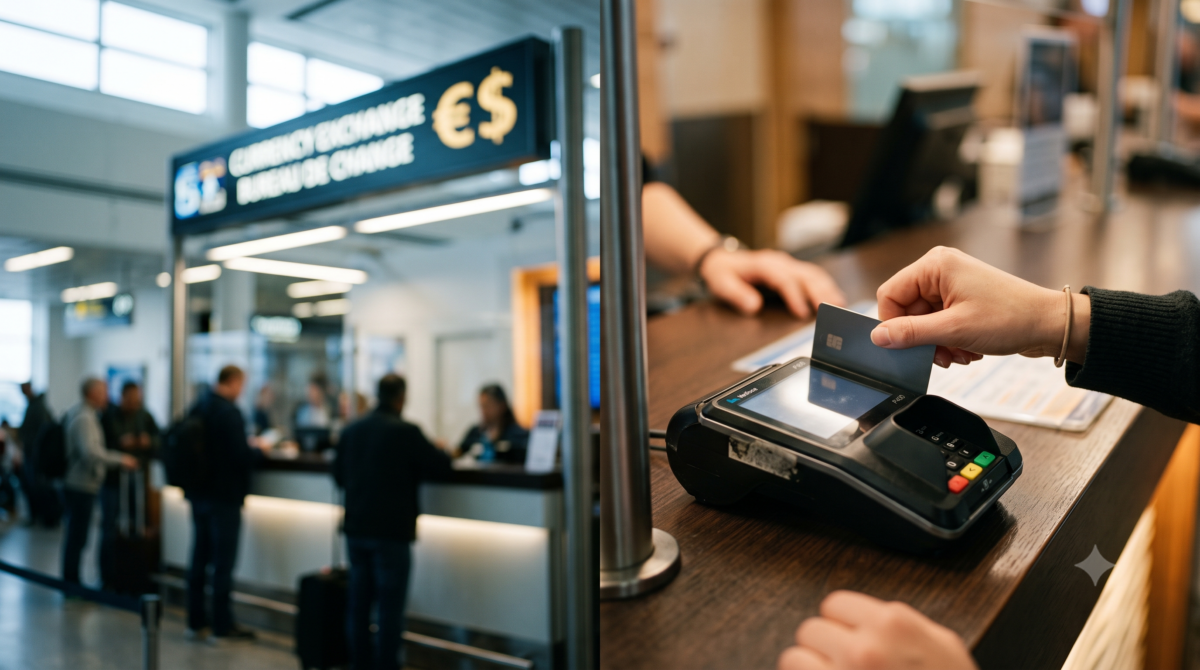
Put a number on each mistake and the pattern becomes obvious: the convenient option is almost always the expensive one.
| Method | Typical Markup or Fee | Best For | Worst For |
|---|---|---|---|
| Airport exchange counter | 5–15% above mid-market rate | Emergency cash for a taxi or snack on arrival | Exchanging a trip’s full budget |
| Dynamic currency conversion (“pay in home currency”) | 2–7% above mid-market rate | Never — decline every time | Card purchases and ATM withdrawals abroad |
| Standard card foreign transaction fee | 1–3% per purchase, ~1.5% average | Everyday spending if you don’t have a fee-free card yet | Cards that also add DCC on top of this fee |
| No-foreign-fee credit card | 0% card fee (network rate still applies) | Most purchases abroad | Cash-only vendors and markets |
| Bank ATM withdrawal | Card’s own FX fee + $2–5 flat operator fee | Cash for tipping, markets, small vendors | Frequent small withdrawals — fees stack per transaction |
The pattern holds across almost every source that tracks this: convenience and cost move in opposite directions. Zero-planning options — the airport counter, the “pay in dollars” button — are consistently the most expensive, while five minutes of setup before a trip, like checking the rate or picking the right card, is consistently the cheapest.
Getting currency right on a trip is one piece of traveling like an Operator. Journo Insider is the toolkit for the rest of it — booking forecasts, deal frameworks, and playbooks that make every trip cheaper. Start the 14-day free trial and claim $6,640+ in travel gifts.
Start your free trial Keep everything even if you cancel.Journo’s Currency Converter checks the real rate, works fully offline so signal is never the excuse, and logs every conversion in its built-in Purchase List so you know exactly what a trip actually cost — free to download, no account required.
Get Currency Converter App+ on the App StoreHow do you put this into practice before your next trip?
Three things to do in the week before you leave, not the day of:
Check your current cards for foreign transaction fees. Look at the terms and conditions or call your issuer — this takes five minutes and tells you immediately whether you need a different card for the trip.
Download an offline-capable converter before you land. Rates cache while you have signal so they’re ready the moment you don’t. Doing this at the airport with roaming off defeats the purpose.
Decide your cash strategy in advance. Most destinations need some cash for markets, tips, or small vendors — decide how much and where you’ll get it (a bank ATM, not an airport counter) before you’re standing in an unfamiliar arrivals hall making the decision under time pressure.
For a full breakdown of which currency converter apps handle the offline-and-tracking half of this best, see our honest comparison of currency converter apps for travelers.
Handling currency well is one Operator habit among many. Journo Insider gives you the full toolkit — when to book, where to stay, how to stack value on every trip. Try it free for 14 days with $6,640+ in gifts.
Start your free trial Keep everything even if you cancel.Frequently asked questions
What’s the best way to avoid foreign transaction fees while traveling?
Get a credit or debit card with no foreign transaction fee before you leave — this alone erases the 1–3% (about 1.5% on average) most cards charge on every purchase abroad. Combine it with always declining dynamic currency conversion at the terminal, since accepting it adds another 2–7% on top of any card fee.
Should I exchange currency at the airport?
Only for a small amount of emergency cash right after landing — enough for a taxi or a meal. Airport currency exchange counters typically mark up rates 5–15% above the real mid-market rate, making them the most expensive place to convert a full trip’s budget.
What is dynamic currency conversion and should I accept it?
Dynamic currency conversion, or DCC, is the option a foreign card terminal or ATM gives you to be charged in your home currency instead of the local one. It sounds convenient but adds a markup of roughly 2–7% above the real exchange rate. Always choose to pay in the local currency instead and let your own card handle the conversion.
Is it cheaper to use a credit card or withdraw cash abroad?
A no-foreign-fee credit card is usually cheaper for purchases, since it avoids both the card fee and any ATM operator charge. For cash, a bank ATM withdrawal is typically cheaper than an airport exchange counter, though you’ll still pay your card’s foreign transaction fee plus a flat operator fee of roughly $2–5 per withdrawal — so withdrawing larger amounts less often beats frequent small withdrawals.
How can I track how much I’m spending in a foreign currency?
Log each conversion as you make it rather than trying to reconstruct spending from memory or receipts after the trip. Some currency converter apps, including Journo’s, include a built-in expense tracker that records a note with every conversion, so the running total is accurate without extra effort.
Do I need to notify my bank before traveling abroad?
Many banks no longer require advance travel notifications, since fraud detection has improved, but it’s still worth a quick check with your card issuer before departure. A blocked card in a foreign country is a bigger problem than any exchange rate, so this five-minute step is worth doing regardless of whether your bank technically requires it.