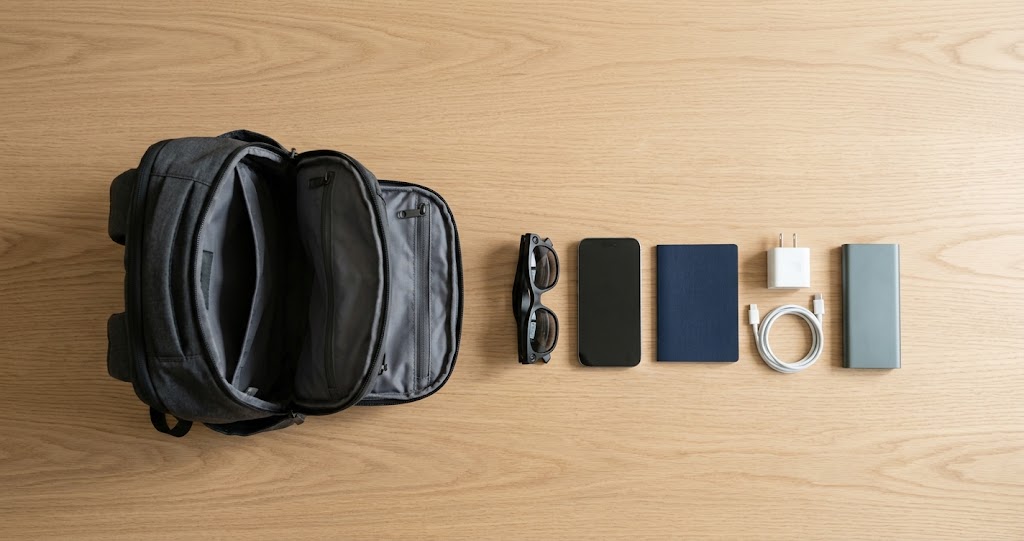
Overpacking is a classic first-timer mistake, and it usually comes from the fear of missing the perfect shot. However, you do not need a ten-pound camera bag to document two weeks in Tokyo. Instead, the simplest way to capture a trip without wrecking your back is to strip your gear down to wearable tech and a single carry-on.
That means no bulky lenses, no fragile action cam and no tangle of headphone cords. You press a button on your frame, and the moment is recorded. Meanwhile, your hands stay free to hold your passport, grab a train ticket or pay for a coffee. Below, you get the real cost of overpacking, what to swap for what, the rules of a tech carry-on, and a quick pack audit that shows how much your gadgets actually weigh.
TL;DR: minimalist travel tech
- Every extra gadget costs you twice: in baggage fees and in the risk of a checked bag going missing.
- Camera glasses can replace an action cam, earbuds and part of your camera kit, because they shoot photos and video and play audio from one frame you already wear.
- Also, standardize on USB-C so one charger and one power bank cover everything you carry.
- The rule of thumb: if a gadget sat unused on your last three trips, it stays home.
- Finally, protect what you record. Know local filming rules, switch off in sensitive places, and only sync over secure networks.
Journo Insider
Get $6,640 in travel gifts — just for saying “maybe”
Start the 14-day free trial and keep the gifts even if you cancel.
Claim your free gifts →No credit card required. Cancel any time.
What is the real cost of overpacking tech?
Extra gear feels like extra options. In practice, though, it mostly drains your wallet and slows you down, because airlines now charge for almost every bag beyond what fits under the seat.
For example, U.S. passenger airlines collected $7.4 billion in baggage fees in 2025, according to the Bureau of Transportation Statistics. So every pound of camera equipment you check costs money, and it also adds risk. In fact, SITA reported that the mishandled baggage rate reached 7.6 bags per thousand passengers in 2022. Handing a hard case of prime lenses to a rushed baggage handler is a gamble you do not need to take.
There is a safety angle too. A heavy backpack full of tripods and spare batteries marks you as a tourist carrying expensive electronics. On the other hand, a light setup lets you move quickly through crowded stations and skip the baggage carousel altogether. Our guide to the true cost of travel covers the other fees that add up quietly.
How does the Travel Decision Stack apply to minimalist travel tech?
The Travel Decision Stack, for your tech bag
- Experience. First, decide what you actually want to bring home: photos to share, video of a few big moments, or just good memories. A gadget only earns a spot if it serves that.
- Real Cost. Next, count the full price of carrying it, not just what you paid for it: baggage fees, insurance, the risk of loss, and the weight on your shoulders all day.
- Timing. Then, pack for the trip you are taking. A week of city walking needs far less than a month of mixed travel, and nobody needs a drone for a weekend in Rome.
- Execution. Finally, build one kit that charges from one cable type and fits in one bag, so setup takes seconds at every stop.
All four layers sit inside the wider Travel Optimization System, Journo’s way of planning trips with fewer guesses.
How do AI glasses replace traditional travel gear?
Over the last decade, many of us bought a niche gadget for every travel scenario: an action camera for the beach, over-ear noise-canceling headphones for the long flight, and a separate mirrorless camera for street photography at night. Unsurprisingly, the camera accessories market keeps growing as amateurs buy more gear.
Consolidating is the obvious fix, and it is the heart of minimalist travel tech. For instance, packing AI glasses with a camera feature cuts dead weight from your daily packing list straight away. They work as an all-in-one capture and audio device, and because you wear them, they take up no space in your bag. In short, you swap three separate electronics for something you would wear outdoors anyway.
Leave: action camera
Point-of-view photos
The lens sits at eye level. So if you spot a street performer in Rome, you capture exactly what you saw, with no fumbling for a lens cap.
Leave: over-ear headphones
Open-ear audio
Speakers built into the arms play turn-by-turn walking directions, while you can still hear traffic and the city around you.
Leave: phone in your hand
Voice commands
Ask the built-in assistant for a translation or a photo, and the answer plays back quietly in your ear while your phone stays in your pocket.
Operator tip
Do a test day at home before you fly. Wear the glasses for a full afternoon out, shoot photos and video, use the directions, and check how much battery is left by dinner. Then you know whether you need the power bank on day trips, and you find out about any settings you hate before you are standing in front of the Colosseum.

Saving on bag fees is the easy win. The Syndicate shows how Operators cover the flight itself with points instead of cash.
Try Journo Insider free for 14 days →What are the essential rules of a tech carry-on?
A minimalist travel tech setup comes from honest editing. In other words, “just in case” items do not make the cut. If you haven’t used a gadget on your last three trips, it stays home.
A curated packing list helps you judge each item on how useful it is, not how useful it might be. Our system for what to pack for any trip works the same way, and the goal is simple: walk off the plane and straight past the baggage carousel.
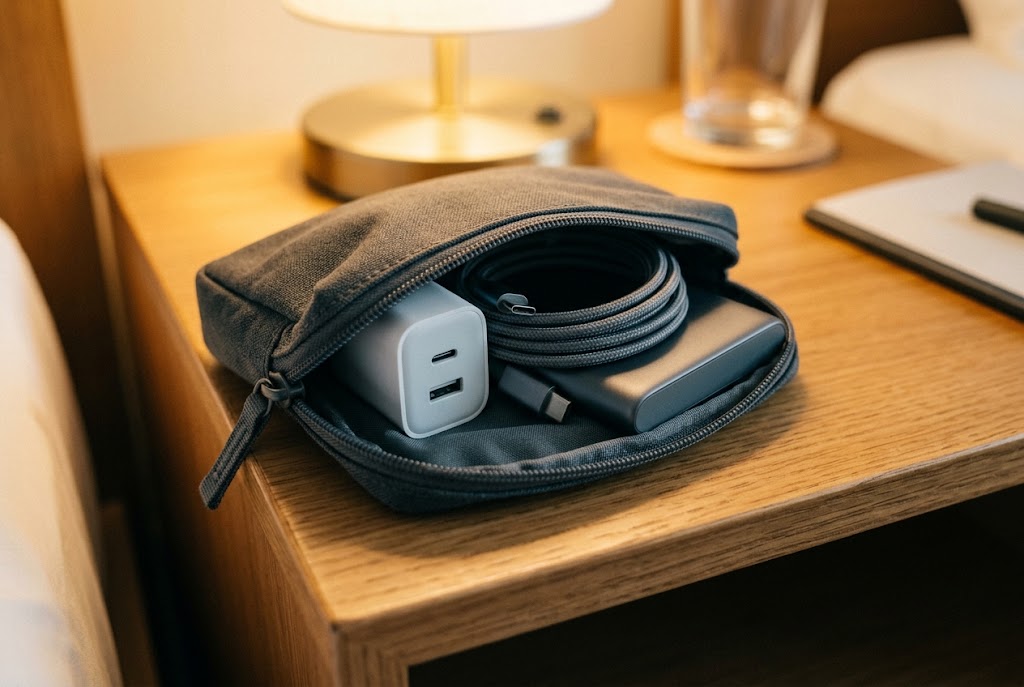
- Standardize your cables. Bring one high-wattage charger with two USB-C ports, and make sure everything you carry charges over USB-C.
- Ditch the drone. Unless someone is paying you for aerial footage, leaving it at home saves you heavy batteries and a maze of local drone laws.
- Wear your heaviest tech. If you need a heavy coat or your glasses, wear them through security. Pockets are free, while carry-on weight limits are often strictly enforced.
- One bag for all of it. Your tech should fit in a 20-liter personal item, such as one of these carry-on travel backpacks.
Anything beyond that is overhead. After all, you are traveling to experience a place, not to run a mobile production studio out of a hotel room.
Pack audit: what does your tech weigh?
Tap the gadgets you were planning to bring. The bar shows how much of a typical 7 kg (15 lb) international carry-on limit they use up. Weights are Journo estimates for common models.
Always in the bag: phone, camera glasses, one USB-C charger and one power bank (about 0.6 kg).
Your tech: 0.6 kg (1.3 lb), 9% of the carry-on limit.
How do you stay safe and respectful when recording abroad?
Easy recording brings real ethical and practical risks. Pointing a big telephoto lens at a stranger in a market is obviously intrusive. Camera glasses remove that visible barrier, but that means you have to be more thoughtful, not less.
Rules on filming in public vary a lot from country to country, so check the local consent laws before you go. Also, a small recording light on your frames will not calm a vendor who doesn’t want to be filmed. Read the room, ask when in doubt, and switch the device off completely in private businesses, places of worship and other culturally sensitive sites.
Your footage needs protecting too. If you lose your glasses or your phone is snatched in a crowded square, anything that hasn’t synced is gone. So set your rules before you leave the airport: auto-sync only on secure networks, and treat open café Wi-Fi as a risk. A reputable VPN adds a layer of protection when you have to use public Wi-Fi.
Operator tip
Turn on the setting that only backs up photos on Wi-Fi you trust, and add your hotel network the first night. Then, at the end of each day, check that the day’s shots have synced before you go to dinner. If your phone or glasses go missing tomorrow, you lose a day of gear, not a trip of memories.
How does a heavy tech bag compare with a minimalist one?
For example, here is a typical “just in case” camera kit next to a minimalist travel tech setup for a two-week trip. Weights and prices are Journo estimates.
| What you carry | Heavy kit | Minimalist kit |
|---|---|---|
| Photos and video | DSLR, two lenses, action cam | Camera glasses + phone |
| Audio | Over-ear headphones | Open-ear speakers in the glasses |
| Power | Four chargers, spare batteries | One dual USB-C charger, one power bank |
| Bag | Camera bag + checked suitcase | One 20-liter personal item |
| Tech weight | About 5.6 kg | About 0.6 kg |
| Checked bag fees | $70 to $80 round trip | $0 |
The best travel camera is the one you are already wearing when the moment happens.
How do you pack light with tech for your next trip?
- Audit your bag. First, take out every item that does only one job, and ask what else could do it.
- Move to wearables. Next, let your everyday eyewear handle audio and most of your photos, and keep your phone for everything else.
- Standardize on USB-C. Then cut down to one charger, one cable and one power bank. A packing list app makes it easy to keep the same kit trip after trip.
- Stop checking bags. Keep your gear on you, which removes the risk of theft in transit or a lost bag.
- Lock down your data. Finally, sync over secure networks only, and use a VPN on public Wi-Fi. Then decide how you want to document your travels once you are home.
Quick answer
Minimalist travel tech means carrying a phone, a pair of camera glasses, one dual USB-C charger and one power bank, all in a single 20-liter personal item. That setup replaces a camera bag, an action cam and over-ear headphones, weighs well under 1 kg, and lets you skip checked bag fees and the baggage carousel.Journo Insider
Pack light, travel better, and keep $6,640 in travel gifts
Try Journo Insider free for 14 days. Keep the gifts even if you cancel.
Say “maybe” and claim your gifts →Frequently asked questions
What is the lightest way to take photos while traveling?
The lightest option is your phone plus a pair of camera glasses. Together they cover everyday photos, short video and hands-free point-of-view shots, and they add almost no weight to your bag. You only need a dedicated camera if photography is the main point of the trip.
Can smart glasses replace a camera for travel?
For most travelers, camera glasses can replace an action cam and much of what a compact camera does, especially for quick moments and video on the move. However, they don’t replace a zoom lens or a camera for low-light and professional shots, so keep a real camera if those matter to you.
What tech should you pack for a carry-on only trip?
A minimalist travel tech kit for a carry-on only trip is your phone, camera glasses or earbuds, one dual USB-C charger, one USB-C cable and one power bank. Add a laptop only if you will work on the trip. Everything should fit in a 20-liter personal item.
Are power banks allowed in carry-on luggage?
Yes. In fact, spare lithium batteries and power banks have to go in your carry-on, not your checked bag. Most airlines allow power banks up to 100 watt-hours without approval, which covers nearly all phone power banks, but check your airline’s rules before you fly.
Is it legal to record video with smart glasses abroad?
It depends on the country. Many places allow filming in public, but rules on recording people, especially for publishing, vary a lot. So check the local laws before you go, ask before filming people up close, and switch the glasses off in private businesses and religious sites.
How do you protect travel photos if your phone is stolen?
Turn on automatic cloud backup, set it to sync only on Wi-Fi networks you trust, and check each evening that the day’s photos have uploaded. Also, use a VPN on public Wi-Fi so nobody can intercept your uploads.
Your travel memories should not need a porter. With minimalist travel tech, you carry the kit that does the most with the least, so when the flight boards in twenty minutes, your hands are free.